Trip Tricks: No Phones

When it comes to trips, we have a strict no phone policy for students. In our culture this can be fairly divisive because of our love for technology and the fear of missing out due to our comfortability with having everything in the palm our hands.

But here’s the thing: phones, social media, and technology, while amazing resources, actually cause us to be more disconnected, distracted, and anxious. That doesn’t mean that phones and technology are bad things, but it does mean we need to be intentional in helping our communities use and respond to them properly.

While social media and phones may seem to help us stay connected, they actually aren’t helping our students build authentic interpersonal relationships with their peers. They are actually engaging in relationships from a distance that don’t supplement the real relationships we were crafted for. Their online relationships may not be a bad thing, but they are no substitute for the real relationships God has designed us to be a part of.

All that to say, phones and technology can ultimately be distracting and hinder growth and maturity on trips. Instead, we desire for our trips to be places that help students grow in their relationships with Jesus and their peers. We want to eliminate distractions in our desire to foster authentic, Christ-centered relationships.

Now in some ways, this is easier said than done. I have heard all the pushback from parents, students, and even volunteers. But the statistics coupled with the results we have seen (deeper spiritual growth, intergenerational connections, ongoing transformation, and greater desire for transformation in their communities) outweigh all of the pushback. We also implement additional means of alleviating some of the pushback.

Prior to the trip, we communicate with students and families multiple times through a variety of methods (emails, social media, phone calls, meetings, etc.) the expectations and rationale for why we don’t allow students to have phones. We also share the ways parents have to reach out to our team.

We share our staff numbers as well as the camp or retreat’s contact information, and highlight that all of our leaders will have phones if contact needs to be made. Our team also posts intentional photos throughout our trips on social media to showcase our students and help families be a part of what is happening.

It should be noted that while we allow leaders to have phones on our trips, we put expectations in place for them as well. We ask them to primarily use their phones for photos and not to simply be on social media, playing games, or anything else that pulls them away from our students.

Over our career in student ministry we have witnessed the benefits of not allowing phones on trips. Typically students are not excited the first or second time they have to give up their phones. We’ve even had some students sneak burner phones into a camp. But as the trip goes on, students start to relax and become less anxious. They engage more with their peers, they begin having more intentional conversations, and they spend more time growing in their faith.

One of the best metrics for us is hearing from the majority of our students how they look forward to not having their phones on trips. They understand the need for healthy boundaries with their phones and for building into their relationships with Jesus and their communities.

At the end of the day this is a choice each student ministry must make for themselves. I’d strongly encourage a no phone policy on trips, but make sure you communicate why you have chosen to do so, be gracious in your conversations, understand where others are coming from, and make sure you and your leaders are fully engaged as you have your phones.

Trip Tricks: Carabiners

Trips are an amazing part of student ministry because they allow our students to connect with God and one another in intentional and transformative ways. If you’ve been serving in student ministry for any length of time, you are well aware of how important trips are and how much our students love them.

The thing with trips though is that we need to be intentional with them to afford our students the best possible experience that ultimately helps them grow in their relationship with Jesus.

The purpose of this new series, “Trip Tricks,” is to share specific ways we have learned to do this over the years. These are not a one-size-fits-all approach, but instead suggestions that can be molded and shaped to fit your program and student demographic.

When I started working at my current church I inherited a variety of things. Some I kept and others I didn’t. One of the things I kept, and am forever grateful for, are carabiners.

Now you may be wondering, “why on earth do you need carabiners for student ministry?” And no, I am not taking my students rock climbing, although that does sound like fun.

Carabiners are our way of engaging in intentional community and encouragement on trips. They provide students and leaders alike an opportunity to get to know new people and build authentic, biblical community as they grow together.

Allow me to explain. Carabiners are simply the tool we use, and you can utilize any other item for this. We take a bunch of small carabiners and a special memento that we clip to it that has one of the individual trip member’s names on it.

We purchased wooden keychains that have our student ministry logo on it and on the backside we created a sticker via Canva with each person’s name, trip, and year on it. We printed that off on sticker sheets and all of a sudden we have a keepsake for each person.

We then connect each keychain to the carabiner and attach all the carabiners to a holder. The next step is setting the stage.

On the first day or night of the trip we explain very simply what the carabiners are by saying something like this: “Each of you has a carabiner with your name on it that you will be able to take home at the end of the trip. During the trip, you will be getting someone else’s carabiner and your job is to get to know them because we will take time each day (or however often you want to do it) to encourage one another in our group.”

This is a little stretching for some people because it may mean meeting new people or getting stretched outside of their comfort zone. But affording your team an opportunity to build intentional and authentic relationships by encouraging and caring for one another will help your team flourish.

Here is how you can start your share time: have everyone sit in a circle and simply ask for a volunteer, pick someone, or lead by example. Each person will say who they have and then speak words of encouragement and affirmation into their life. Then they hook their carabiner onto the holder and pass it to the person they just encouraged. This continues until everyone has gone.

Now if it doesn’t go in a perfect circle and someone gets called on who already went, we allow them to choose who goes next. Once everyone has shared, you can hand out the carabiners again but make sure everyone gets a new name that isn’t their own.

Typically on a weeklong trip we try to do carabiner sharing at least five times. But that is how our group does it and it is subjective to the group and trip dynamic.

I’ll be honest, the first few times your group does this may feel a little awkward or indifferent. But the more you embrace it and lead by example, the more impactful this time will become. You will begin to see a culture and relational shift among your team as they begin to engage in Christ-centered ways.

The whole point of carabiners is to draw your team closer as they embrace the authentic type of relationships that God desires for us. As they begin to understand what true, authentic, biblical community is about, your team will draw closer together and crave more of what God desires for us.

Fun Game Ideas for Student Ministry

If you’re like me, games may not be your primary focus each week. I am not saying games are bad; I think they are a necessary and important part of student ministry.

But if I’m being honest, I don’t always think about them because I am not always wanting to lead games. I’d prefer to engage in conversations and just float around while interacting with students.

But, since I know how important games are, I wanted to share some ideas with you that are fun, easy to run, and do not take up a ton of prep time.

The Floor is Lava

This is an old school game that has been having a recent resurgence. If you aren’t familiar with the rules, the game is fairly simple: do not touch the ground or you are out.

The object of the game can vary from completing tasks like collecting objects or moving a team to a safe zone, to completing an obstacle course, to a last person standing challenge. The game can be as creative as you can imagine and will allow various people to play.

Seated Basketball/Soccer/Football

This is a personal favorite of mine. These games take the traditional sports we love and turn them on their heads. You do not have to be super athletic to play these games because you are seated the entire time.

Before you start the game, set up your playing area whether it is indoors or outdoors. Simply place chairs where players will sit the entire game or period and label which team they are for. Then have your students pick a chair and get ready to laugh.

The rules are the same for whatever the game is with one addition: students cannot move from their chair. Have leaders roaming to place the balls back in play when needed. You can also change up the rules and objectives to add another layer to the games.

Hula Hoop Volleyball

This is an easy game to set up and run with. Simply set up a volleyball net, or something in place of it like a sheet on a clothesline, and then place hula hoops on each side that are six feet apart. The rules for volleyball don’t change, except that students may not leave their hula hoop during the game unless it is to rotate spots during a change in servers.

Scattergories

This is a great game to play as a small or large group. You can do a quick Google search for categories and then run the game during youth group. You can simply click through the Google images to get ideas or check out a website like this one.

If you are playing as a small group give everyone a score sheet and have them all compete against one another. You or a leader will assign a letter and have the students write words beginning with it.

If you have a larger group, consider setting this up tournament style. Have students all compete with same letter and then when time is up they will compete only against the other person at their table. The winner will advance to the next table, while the loser stays at the table. If there is a tie have them play Rock, Paper, Scissors to decide the victor. The person with the most wins at the end is the champion.

Cornhole/Bags Tournament

If you do not have a couple sets of these for your youth ministry, let me highly encourage you to get some. I have purchased these before and they have held up very nicely.

You can turn it into a tournament to decide who is the best cornhole player. You can also set up varying degrees of game play (i.e. closer or farther away) to make it more of a challenge for your students.

Charades

Who doesn’t love a classic game of charades? The general idea is that you will have someone acting out an action, character, or activity that they have pulled from a hat. These can be pre-made by you and your volunteers or you can have students submit them.

There are lots of different ways to play Charades like as small groups guessing, or as a large group guessing, or even reverse charades where one person guesses while the whole group acts it out. Whichever one you choose, make sure to remind the people acting out that they can not make noise or they forfeit that round.

Head, Shoulders, Knees, Cup

Have you ever played head and shoulders before? You know the one with the classic song? It’s an easy game because you simply need an emcee up front who calls out what everyone needs to do. If they say head, everyone touches their heads. If they shout knees, then everyone touches their knees. In this version two people are facing each other with a cup on the ground in between them. The object of the game if simple: follow the directions and then when the emcee yells “cup,” both players try to grab the cup. The one who doesn’t get the cup is eliminated and the winner finds a new partner to compete with. Bonus tip: make sure there is enough distance between the players so they don’t bump heads when going for the cup.

Pull Up

All you need is a sound system and music, and someone who can start and stop the audio when needed. Have your group sit on the floor in a circle facing inward. Then choose an odd number of boys and girls to be in the middle. When the music starts the students in the middle must go to a member of the opposite gender, extend a hand, and “pull them up”. They then sit in the open spot and that new student in the middle continues by pulling up a member of the opposite gender. This continues until the music stops and the gender with the most people in the middle loses. Play for as long or short as you would like.

Drip, Drip, Drop

For this game you need just a little bit of prep: paper cups and water, and some towels if playing inside. I’d encourage you to play outside so you don’t have wet carpets. Have your students sit in a circle facing each other much like Duck, Duck, Goose. Pick on player to be it. They stand outside of the circle and are given a cup with a small hole in the bottom. Have them place their finger over the hole. When they start they go around the circle saying “drip” and dripping a small amount of water on the students’ heads. When they yell “drop” they turn the cup upside down on the person and have to run around the circle while being chased by the person they dropped on. If they make it to said person’s spot they are safe. If they are tagged they are it again.

Egg, Chicken, Dinosaur

This is a great alternative to Rock, Paper, Scissors and is really easy to pull off. Explain how to play Rock, Paper, Scissors to the group. Then explain that in this game you can only play with people who are the same as you: i.e. an egg, chicken, or dinosaur. Eggs can only play eggs, chickens can only play against chickens, and dinosaurs against a dinosaur. The kicker is they must walk or waddle in a manner that is befitting of an egg, chicken, or dinosaur. Participants all start as eggs. They must find another egg and play a best 2 out of 3 round of rock, paper, scissors, and if they win they become a chicken. When a chicken wins they become a dinosaur. If they lose a round they go back one level.

Lightsaber Duels

Participants must place one hand behind their back. They will then join in a battle with another person by locking their one hand with the other person’s hand. Students will then extend their pointer finger as their lightsaber. When the music starts they attempt to touch their “lightsaber” to the other person. They can “zap” them anywhere but they cannot bend their finger to complete a touch. If they are zapped they are out. The winner keeps advancing until only one remains.

Bucketball

This game requires some prep and a few quick items. Make sure you have buckets, cones, pinnies/colored shirts, and balls on hand before you play this game. For set up, place a bucket in the middle of a ring of cones for each team where one player (the scorer) will hold the bucket (approximately three feet in each direction from bucket to cone).

Divide your students into groups (we usually just do two but having more groups makes it interesting) and assign each group colored pinnies. The game is played in the same manner as ultimate Frisbee where the students must pass the ball down the field and are only allowed three steps with the ball. Points are scored by players throwing the ball (after three or more passes) to their scorer. The scorer will hold the bucket within the ring of cones and attempt to catch a ball in the bucket. Only balls that stay in the bucket count. The scorer may not go outside of the cone ring and the defense and offense may not go inside the cone ring. Feel free to add as many balls to the game as you would like.

Seated Basketball/Soccer

For this game you need a few items: chair, pinnies, balls, and extra leaders or students to collect stray balls. This game is played just like soccer or basketball in that the goals are the same which means you obtain points how you would normally (i.e. kicking a goal, making a basket). Divide your students into two teams and give them their pinnies. If you are playing soccer have the students remove their shoes to prevent potential injuries from kicking one another.

Have your students then grab a chair and give them 15-30 seconds to place their chair. Explain that this is the only place they may sit for the first half/quarter. Once they sit they may not move from that spot. When everyone has sat down introduce the balls for the game and explain that students must remain seated all the time, and failure to do so will put them in a penalty box. Explain that if no one can reach a ball it will be placed back into play by a leader. Assign times for your halves/quarters and then when a new one begins allow students to find a new spot to sit.

Cat and Mouse Tag

Have students pair up and link arms at the elbows. I would recommend not allowing them to hold hands or wrists as it can lead to injuries. Pick two students to start the game. Explain that one will be the cat who is it and will chase the other student who is the mouse. At any point during the chase the mouse can link up via their arm with a group and the person who is now on the outside is the new mouse. If the mouse is tagged then the roles are flipped and they are now the cat, and the cat is the mouse.

Death Sticks

Take some pool noodles and cut them in half and have your students each grab a chair. Place an odd number of pool noodles on an equal number of chairs in the middle of a large circle of chairs that your students make. Have each student sit in their chair. Then chose an odd number of students to stand in the middle that is equal to the number of chairs with noodles. Explain that this is a guy versus girl game (or however you would like it to be) where when the music starts the guys must take the noodle and bop a lady on her legs, and ladies must do the same to guys.

Once someone is bopped the person with the noodle must return the noodle to the chair they took it from (no throwing it must be placed) while being chased by the person they bopped. If the person who was bopped manages to retrieve the noodle when it placed down and bop the person who bopped them before they sit down in the vacant chair that person returns to the middle. If they cannot they are now in the middle and can bop someone. Winning team is the team with the least of their gender in the middle. And remember that a bop is a soft hit, not smacking someone hard with the noodle.


Review: The Bodies Behind the Bus Podcast

Elise and I make a habit out of trying to listen to a wide variety of podcasts. Some are humorous, others are true crime, many are focused on ministry, and still others focus on sharing stories and critiques on ministry, leadership, and toxicity.

The Bodies Behind the Bus podcast focuses on the latter part of the list and truly seeks to help the church and ministry leaders be better at how they love, shepherd, and lead the church.

I do want to pause and address the “why” for a moment. Some of you may be asking, “why would you share a resource that can critique the church harshly and point out its flaws?” I think rather than simply ask that question we need to look at the causation for said question.

The cause is this: the church is made up of broken people and when broken people lead without checks, balances, and accountability, problems can and will arise. This leads to toxic leadership, unchecked authority, and a culture of harsh management and fear. This is the “why.”

When the church is made up of broken people, we must be striving to grow and be more aware to protect ourselves from falling into those categories as well as learning and empathizing with others who have been recipients of those negative behaviors.

With that being said, here is why I recommend this podcast. The hosts alternate between interviewing individuals who share their stories, digging deeper into hot topic issues surrounding churches, leadership, and culture, and dialoging about how the church needs to grow and change.

These episodes are highly informative and helpful to understand how to be a better leader who shepherds and cares for the flock. It also helps congregants and lay people understand what healthy leadership should look like while providing helpful and thoughtful ways to engage with your leadership.

The stories you will hear will pull at your heart as you empathize and sympathize with the story tellers. You will hear stories about churches and leaders you may know and many you do not. But by listening to each episode, you are allowing yourself to be shaped into a better leader by learning first and foremost how not to lead but also by becoming a better listener and shepherd for your people.

So often in the stories shared, people aren’t listened to and are dismissed. By allowing your heart and mind to hear these stories, you’re positioning yourself to be a better listener and leader because you’re seeing people where they are at and growing in your relational and emotional intelligence.

I will say this when it comes to The Bodies Behind the Bus: it may be helpful to take your intake slowly rather than the firehose method. These episodes, especially interviews with survivors, can be heavy and soul crushing. They are raw and can feature strong language, and as you hear the stories, stats, and fallout, your soul will grieve deeply. Because of that, it would be helpful to listen to the podcast in bite sized chunks rather than trying to power through many episodes at once.

You may not agree with everything in this podcast. I don’t expect you to. What I would challenge you to do is listen to it and allow for there to be room for empathy and sympathy in your heart as you hear the stories. Then allow for that to help mold you into the shepherd God has called you to be.

Quick Tip: It Never Hurts to Ask

“Hey Nick, if you ever need any candy for youth group, all you need to do is ask!” I’ll never forget that conversation with, at that time, a new leader for our middle school ministry. From that point on any candy needs we had, he covered them.

Whether it was providing candy for special events, chocolate bars for s’mores, or just a bag of candy on my desk as a thank you; candy was simply an ask away. But you know what that simple conversation helped me understand? All I needed to do was ask if I had a need.

But here’s the thing: in the past, I have struggled to ask when there’s a need. Whether it’s a pride thing, comfortability, a lack of awareness, or a combination of all the above, I struggled to ask.

Now guess what? When I started to ask, when I shared what our needs were, our church community rallied to our cause. I would never have considered asking about candy being provided, even though we live in an area that has multiple chocolate companies just down the street from our church. But because a volunteer approached me with a way to meet a need, it helped me remember something: the church is in this together and they want our young people to succeed.

So what could you ask for? Of course we all jump to volunteers because that’s what we all need. But what if we saw beyond that? What if we asked for people who would be willing to open their homes or prepare a meal? What if you shared needs for supplies and resources? What if you simply asked?

Over the past couple of years we have begun sharing our needs more openly and it has provided us with so many amazing new relationships, community engagement, and ways to better bless and care for our students and leaders.

Here’s the rub: asking someone for something isn’t bad. It is a huge asset and a way for the church to be the church. But even if the request is denied, remember to say “thank you” and don’t let it defeat you. Keep asking. Keep sharing the need. And watch what God will do through the church body.

Resourcing Leaders

Elise and I have each been in youth ministry for twenty plus years. That’s crazy when we step back and think about how things have changed during that time. Technology has evolved. How youth groups do things has changed (bye-bye “Fear Factor” challenges). Styles and culture have changed. Students are walking through more difficult things.

Have you seen how things have changed and evolved over the last couple of decades? What about over the past five to ten years? The reality is that our culture and what our students are walking through has changed drastically and will continue to do so. But with that can often comes a feeling of ineptness for ourselves and our volunteers.

If you’re like me you may remember the first time a student came to you about a new issue you hadn’t been taught how to respond to. Maybe it was about eating disorders or disordered eating. Perhaps it was about sex, sexuality, and gender. Maybe it has to do with cutting and self harm. Or was it the time a student talked about the reality of their mental health and how it was affecting them.

Do any of these sound familiar? Have you ever had a student come to you with these issues or any of the litany of others we deal with? Here’s the thing: many of us have had some type of formal training if we are on church staff. Whether it was a single semester class, listening to podcasts, going to conferences, or additional resources at your disposal, you probably have more knowledge than some of your lay people when it comes these issues by nature of your role and responsibilities.

That is not a slight against our volunteers, but instead a challenge for us to be aware of what our people need. Typically, those of us who are leading ministries have more knowledge and awareness of issues or we know what resources to utilize when needed. The majority of our volunteers may not have the same knowledge or background and because of that we bear the responsibility of helping to resource and equip our people.

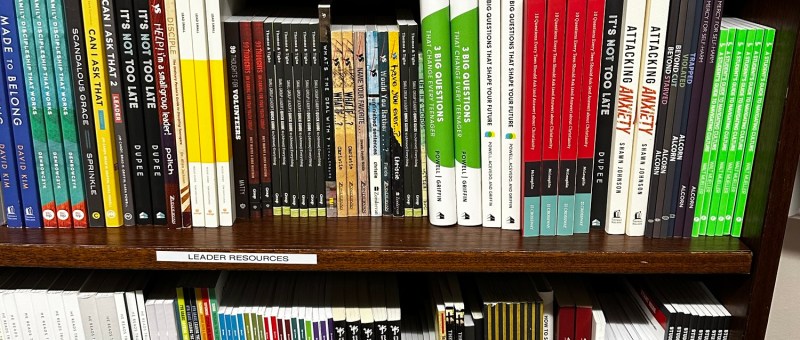
With that responsibility in mind, we should do all we can to help our people when different issues or circumstances arise. I understand that for many ministry leaders, paying for resources may not be feasible each year or at all. The resources you stock don’t necessarily have to be resources that require you to pay for them.

You could download and print out articles to share. Podcasts are an easy option to resource to your leaders. Websites like The Bible Project have videos, articles, and more for your leaders. Some national ministries may also be willing to send you resources at a discounted rate or for free if you reach out to them about your circumstances.

If you are able to purchase items for your leaders here are some ideas for what you could utilize to resource them.

Study and Journaling Bibles: Having study bibles or journaling bibles for your leaders and students to utilize in small groups, discipleship relationships, or for individual study are great resources.

Bible Study Resources: Equipping your leaders with resources to help students study the Bible is a huge win. This will help your leaders feel prepared and ready to walk with students through God’s Word and help them understand it.

Bible Studies: We love She Reads Truth and He Reads Truth for all of their materials. Their Bible studies are great for students because they don’t speak down to them or try to be hip and cool. Instead they offer topical, whole book, and character Bible studies. While these may seem a little costly you can get digital versions for less and if you subscribe to their emails, you can watch for sales including their clearance sales when books are significantly marked down.

Topical Books: If I have learned anything throughout my years in ministry, it’s never be surprised by the questions you are asked. Whether from students, parents, or leaders, the questions will always be there and they will span a wide swath of issues and circumstances.

With that in mind, we have curated books on a variety of topics to help people think through and navigate different issues. We have books on mental health issues, books on hot button issues in Christendom, books about identity, books on community, small group leading, and more. Basically if we saw a book that would be helpful, we allocated part of our budget to begin building a library of resources.

Scriptural Citations and Resources: One thing we have started to accrue over time is a running list of Scripture references for a variety of issues. So often students are looking for answers and ask “what does God think about this” or “what does the Bible say about that.” Having a running list of references allows us to resource our leaders and to point them toward what the Bible has to say.

What resources do you make sure to give to your leaders?

Quick Tip: Caring for Leaders

Have you ever had a leader experience loss? How did you respond? Has a leader on your team ever had a surgery or prolonged illness? Was there a celebratory moment like a college or graduate school graduation? Has there been a birth or adoption within your community?

When it comes to caring for our people, we need to practice intentional community and support for them. Often we can default to monetary care, and while that can be a part of caring well, we can and should be thinking about different opportunities to love and support our community. But what are some additional ways to care well during difficult or celebratory moments?

  1. Send a personal handwritten note or card.
  2. Pray with and for the individual.
  3. Visit with them and make sure you have allotted the appropriate amount of time to visit.
  4. Send flowers and/or balloons.
  5. Send a gift card to your local supermarket or DoorDash to help provide meals.
  6. Start a meal train and bring a meal by yourself.
  7. Encourage your youth group to write cards to the individual.
  8. Put together a gift basket with contributions from your leaders and/or youth group.
  9. Help out with any service projects around the home and encourage your students to help with these.
  10. Check in and see if they need help with childcare or pet sitting.
  11. Ask families to contribute to any of the above ideas.

These aren’t meant to be a catch all, but instead to challenge us to think creatively when it comes to caring well for our people. We want them to know they are seen, loved, and missed and these are just some options that help us to think outside of our normal ways of doing things.

Quick Tip: Work Within Your Ministry’s Seasons

How does your youth group function year round? Does your calendar primarily look the same month in and month out? Are there rest periods or seasons where ministry slows? Is your attendance the same throughout the year?

As we approach the end of the school year, our student ministry at our church shifts its programming model to a more laidback style because we live in and serve a tourist town. What that means for us is lower attendance during the summer due to locals retreating on trips and vacations as tourists come in.

And you may ask yourself, “What about the tourists, don’t you want to have something for them as well?” The truth of the matter is that for all the tourists who visit Hershey, Pennsylvania, very few are looking for a church to attend on a Sunday or youth programming on a Wednesday evening.

It isn’t that we don’t care, it’s that we shift our model to address the realities of our community and best minister to our people when they are present. We host monthly large group gatherings that are highly relational and community focused. We intentionally encourage small groups to gather and share life together. Our staff team is highly visible and building relationships on Sundays.

The truth of the matter is this: each of the communities we serve in have ministry seasons and they all will look different. If your students are around the entire year, you may continue with programming straight through. If summer is a down time, you may switch up how programming looks. If you take trips during spring break, then your programming will look different.

For each of us, we need to look at the communities we serve and ask how our ministry is and should be functioning. We also need to consider other aspects like our volunteers and protecting seasons of rest and refreshment. There are additional pieces like thinking through the taxing role that running full programming yearlong will take on your facilities team. And there are many other questions we can ask depending on what out context looks like.

What we need to consider is how our ministry looks throughout the year, and what programming looks like in each season. When we step back and take an honest assessment, it allows us the opportunity to consider new and exciting ways of facilitating our ministries to best care for and reach all the students we are serving.

Encouraging Your Leaders to Rest

I don’t know if you have leaders like I do, but I’ve noticed that my leaders tend to give 110% all year long. They show up not just when we have programming, but they also go to activities, stay late or come in early to talk to students, engage over the phone and social media, and put in countless hours on trips.

But have you ever considered encouraging them to take a break? I know that for some of you this is an obvious “yes” but for others it’s probably a “no.” I’ve worked in environments where the expectations on leaders is they keep showing up year round and if they had to take a break it was frowned upon. And then others where there’s no structure and people just come and go.

What I’m arguing for is a balanced approach where there is structure and expectations but not to the degree of overworking or burning out our people. We need to actually encourage them and challenge them to pause and refresh so they are the best version of themselves and ready to pour into our students. But how do we do that?

Model it.

Pause and consider this for a second. Do you model resting well? Are you showing your people that taking a Sabbath isn’t just a good thing but something we are commanded to do by God? Have you taken breaks, retreats, or a rest day? If we aren’t modeling resting well to our people, then why should they rest?

We need to highlight, talk about, and model rest to our people. Help them to know how to rest well. Show them that resting isn’t quitting. Help them to see why we all need to rest.

Encourage it.

This is similar to modeling rest, but it’s now being spoken out loud. Talk about rest. Highlight its importance. Bring it up in group settings and in one on one conversations. By encouraging rest, we are helping to keep our leaders from overworking, overcommitting, and burning out.

It is a preemptive approach and a biblical one that we often push to the side. So by highlighting and talking about it, we are encouraging our leaders to be more in tune with living as Jesus has called us to live.

Respect boundaries.

This is key! When was the last time someone texted or called you on your day off? Or maybe the question is this: when did you last check your work inbox or think about all the stuff you had to do at work on your day off?

The truth is we aren’t always great at respecting our own boundaries, so why do we think we will respect them period? What we need to do is start setting boundaries for ourselves, and by modeling that to others and encouraging them to have boundaries, we are helping them to build rhythms of rest into their lives.

Encourage them to have “do not disturb” set on their phones. Challenge them to disconnect at times. Remind them that they don’t need to be all things to all people which means they don’t always have to respond. Help them to be present in the moments rather than always be engaged outside of the moment (i.e. when you’re with family, you are fully present with them). These rhythms will help them to breathe, pause, and rest in ways that we should.

Schedule breaks.

One practical way you can help your leaders rest is by intentionally scheduling breaks for your program. Take time off around major holidays, take a break before or after a trip, consider shifting summer programming, or just schedule regular sabbaths in for the team. When you incorporate intentional breaks and communicate the “why” behind the break, you’re caring well for your team and helping them embrace rest.

Communicate the “why.”

Just like I shared above, communicating the “why” behind rest periods is essential. You’re highlighting your reasoning, the biblical support, and the value this is for your ministry, leaders, and families. So when you communicate this, remember to communicate not just to leaders but also to families. Help them to see the why, and encourage them to rest as well.

Ideas for Celebrating Baptisms

Easter is an amazing time of year for Christians. Your church is probably gearing up for Good Friday and Easter services. In fact, this time of year is probably shaping up to be pretty busy for you and your church. I can relate to the busyness. Our church has extra services and it feels like it’s all hands on deck.

But one of the amazing things we do during the Easter season at our church is celebrate baptisms on Palm Sunday. It’s become a tradition within our church and it is a great opportunity to invite people in our community who don’t usually attend church to join us.

The individuals who get baptized invite their neighbors, friends, and families as they embody the mission that Jesus gave to all of us in Matthew 28. We then are able to invite them back the following week for Easter and connect them further with our church community.

I don’t know about your church experience, but as I was growing up baptisms were not necessarily celebrated. They happened in church services but were fairly muted in how people responded to them.

What I love about our church is that we have shaped our baptisms into a full service that celebrates and highlights what God is doing in the lives of our people. But how do we do that well? How do we elevate and celebrate the Great Commission within our communities?

Make it community-oriented.

One of the things we do is we encourage families, friends, small groups, and others who have been influential in the person’s faith journey to come up with them. They surround the baptismal and are there to show that they are for the individual and love them deeply. It’s an amazing picture of unity and fellowship within the Body of Christ and it is a wonderful encouragement to the person being baptized.

Create a unique service.

I know this takes more time and potentially more people depending on your church size. But what if the Spirit of God moves and 20 people (or more) want to get baptized? That happened to us and we had to radically alter the service. Our senior pastor was the one who stated, “It’s not that we aren’t having a sermon, it’s that we are having multiple sermons with practical application.”

Simply put: the testimonies are the sermon. It may mean shifting songs and service order. It may mean calling an audible and not having certain elements. But by creating a unique setting and elevating what God is doing, you are making the ordinance of baptism special for the people being baptized and your church overall.

Have a time of celebration.

This could be cookies and lemonade after the service. It could be a photo booth and balloons. Or perhaps it’s a church potluck or BBQ. Whatever way you choose, crafting a time of celebration helps your people see that baptism isn’t just a moment but is an opportunity to continue engaging with one another and sharing the Good News with others.

Have a gift ready.

I get it. Money is tight, and we are feeling it in our budgets. I’m not advocating for anything lavish or over the top. This could be as simple as a handwritten card. Perhaps you’re able to put a small gift card in with it. Maybe you can actually put together a small gift bag with a devotional. Whatever you’re able to do will make this day even more special and memorable for the people getting baptized.

Follow up.

After a couple of days, and when appropriate, ask the person out for coffee or lunch to catch up and see how they are doing. Ask questions about what they remember from their baptism. Ask them who they have shared their story with. See how you can continue to help them on their faith journey.

These moments of intentional follow-up highlight that the church and you care for these individuals and want to help them grow in their relationship with Jesus.

How do you celebrate baptisms in your church?