Encouragement for this Season

For so many of us, life during the pandemic has been a struggle we could never have imagined. And trying to do ministry in the midst of it may have left you feeling more discouraged than ever before. Wherever you are in this season of life, we want to offer some encouragement, with the hope of lifting each other up so that we can continue to fight the good fight.

It’s okay to struggle.

I think sometimes we can convince ourselves that if we’re struggling, we’re not doing something right. We can subconsciously believe that things related to our faith should come easy, should feel a certain way. We can believe that struggle is a sign of weakness, and as leaders in the church, shouldn’t we be the strong ones who do not struggle? I think the devil likes when we are here, when we think we’re alone and no one else will understand, when we think we must project an image of strength. But the Bible says something different.

But he said to me, “My grace is sufficient for you, for my power is made perfect in weakness.” Therefore I will boast all the more gladly of my weaknesses, so that the power of Christ may rest upon me. For the sake of Christ, then, I am content with weaknesses, insults, hardships, persecutions, and calamities. For when I am weak, then I am strong.

2 Corinthians 12:9-10

If struggle, or weakness, means Christ will be all the more glorified through us, then it is not something to be reviled. If it humbles us to see that we can only serve by God’s grace and power, then it rids us of unhealthy expectations and feelings of pride. Our natural tendency is to resist things that are unpleasant or difficult, but instead we should challenge ourselves to look for God in those places. Ask Him what He is doing, what He wants to teach us, and what He wants to accomplish. This will give meaning and purpose to the painful places in life, and quite possibly help us to see that there is a point to the struggle.

More than that, we rejoice in our sufferings, knowing that suffering produces endurance, and endurance produces character, and character produces hope, and hope does not put us to shame, because God’s love has been poured into our hearts through the Holy Spirit who has been given to us.

Romans 5:3-5

You are needed.

Ministry jobs can be extremely thankless. In fact, they can be some of the most painful jobs because everyone is a critic and their criticism can be easily directed at you. If your personality type takes critical comments to heart, it can be difficult not to get bogged down in the mess. You might begin to question yourself, your abilities, even your calling. But the truth is, God’s “gifts and calling are irrevocable” (Romans 11:29), and He has given you your unique gifting for a purpose.

But one and the same Spirit is active in all these, distributing to each person as He wills. For as the body is one and has many parts, and all the parts of that body, though many, are one body—so also is Christ. For we were all baptized by one Spirit into one body—whether Jews or Greeks, whether slaves or free—and we were all made to drink of one Spirit. So the body is not one part but many. … But now God has placed each one of the parts in one body just as He wanted.

1 Corinthians 12:11-14, 18

The truth is that you are needed within the local and global church. You have a unique calling, a gift ordained by God for you to use in service to Him. Because of this, you have a special part to play in His kingdom work, regardless of what anyone else says. You may not hear it often enough, so let me say it: Thank you for what you do. You are important, valuable, and necessary to the body of Christ.

Don’t give up.

Some of the most painful moments in ministry have been the ones where I’ve watched people walk away. Not just from me, or from the church (though those hurt immensely), but from Jesus Christ. To have someone you once looked up to, or counted as a co-laborer, give up on their faith and walk away is jarring, discouraging, and can leave you asking a million questions. We could get into a conversation about whether their faith was genuine to begin with, but in the end only God knows. The important thing for us as ministry leaders is to carry out the work we have been given, to fulfill our calling, and to fight with all the power of heaven to never give up.

Finally, be strengthened by the Lord and by His vast strength. Put on the full armor of God so that you can stand against the tactics of the Devil. For our battle is not against flesh and blood, but against the rulers, against the authorities, against the world powers of this darkness, against the spiritual forces of evil in the heavens. This is why you must take up the full armor of God, so that you may be able to resist in the evil day, and having prepared everything, to take your stand. Stand, therefore, with truth like a belt around your waist, righteousness like armor on your chest, and your feet sandaled with readiness for the gospel of peace. In every situation take the shield of faith, and with it you will be able to extinguish all the flaming arrows of the evil one. Take the helmet of salvation, and the sword of the Spirit, which is God’s word.

Ephesians 6:10-17

There may be seasons of life where you have to take a break from doing full-time ministry. You may need a season of healing, time to recuperate and allow God to heal the broken places. Those are good, necessary things. But I want to encourage you, especially in the moments of pain, do not allow your heart to be pulled away from God. Let Him be the source of life, light, and restoration. Find others who love Jesus and can walk with you, helping you to remain rooted and focused on Him. When human relationships fail you, because undoubtedly they will, remember that the ultimate fight is not against humanity, but against the darkness.

The Lord is my light and my salvation— whom should I fear? The Lord is the stronghold of my life— of whom should I be afraid? When evildoers came against me to devour my flesh, my foes and my enemies stumbled and fell. Though an army deploys against me, my heart is not afraid; though a war breaks out against me, still I am confident.

Psalm 27:1-3

In these difficult times, we want you to know that you are not alone. Part of the reason we started Kalos was to create a safe place where we could help nourish and build up the student ministry community. We want to encourage and support you, and for all of us to be able to support each other. If you would like prayer for a general or specific need, please contact us. If there is a topic you would like us to cover in a future blog post, please let us know. We are in this together for God’s kingdom and eternal glory.

Fact or Fiction: You Need Kids of Your Own to be Effective in Youth Ministry

“How do you think you’ll be able to lead and shepherd our kids if you don’t have any?”

That question shocked me. It was during a meet-and-greet with parents from the student ministry program, and honestly I wasn’t prepared for it. What that parent didn’t know is that Elise and I want to be parents but have been dealing with infertility for a long time. That comment hurt and is still an active memory, but I understand that comment wasn’t focused on our infertility but an age-old myth about youth pastors.

Today’s myth is, “You must have your own kids to be an effective youth pastor/worker.”

The truth is that having kids of your own doesn’t make you a better pastor. Similarly, if a pastor has children who reject Jesus, that doesn’t make them ineffective because their kids turned away. Anyone can be an effective youth pastor if that is where God has called them. But I do believe that for those of us without our own children (and arguably even those with children) there are things we should be doing to help us grow and minister to the students under our care.

Be a student of culture.

Let’s be honest: culture can be confusing. And not just for us, but for our students as well. That means we need to be studying what culture is saying to our students. We should be listening to what they are listening to and dissecting what they are being told. Watch what they are watching and see the messages that are being passed to them. Observe advertising and what is being peddled as “in style.” Use all of these things to understand what is happening and what your students are being taught.

A couple of great resources for studying culture include CPYU, The Source 4 YM, and The Source 4 Parents. These websites offer different critiques and viewpoints of popular music, movies, and games, as well as helpful resources designed to help you succeed by knowing in what your students are engaged. An added bonus is they give you practical ways to minister to students and families as well.

Listen well.

Students today desire people who not only spend time with them, but listen to them. Students want to have leaders who care and love them enough to actually listen when others do not. And as you listen to them, you will learn more about them: what they like and don’t like, the new slang, the popular shows they are watching, what social media platform is most utilized, and the list goes on. Being an effective youth leader means you are listening and growing as you listen.

Engage with students.

This is huge in our line of work, and can be missed even if you do have kids of your own. In order to understand and minister to students, you must be engaged with them. Go to their plays, concerts, and sporting events. Support them in their endeavors. Visit them at their jobs. Being present with your students physically is huge, but it is not the only way you engage with them.

Be willing to engage with them at a spiritual and emotional level as well. Listen when they speak. Make eye contact with them. Ask follow up questions. Challenge them. Encourage them toward Jesus. And always keep your word. Doing this not only values them, it allows for you to connect with them at a deeper level. It also gives you insight and wisdom in how to walk with them during these formative years.

Be a life-long learner.

Things change constantly and we must be willing to grow and adapt as well. Gone are the days of the 90s youth pastor. Students now value genuine interpersonal relationships with people who truly love and care about them. That means we must be willing to change as the world changes. No, we do not change or flex on the value of God’s Word and the truth of it, but we do adapt to how we do ministry and engage with our students. That means that you must be willing to continue to learn and grow as an individual and a shepherd.

The easy way is to sit back and think you have it all figured out because you have done this for years on end, you have had a successful program, or you have the right speaking chops. But the truth is that once we have convinced ourselves we have it all figured out, we have actually become replaceable and irrelevant. And I would actually assert that if any of us were to get to that point, we should step away from ministry and reassess why we are in it. See, the truth behind those thoughts is that everything about the ministry and calling God has placed on your life is all something you have done. That is why we stop learning and growing. We must remember that everything we have is a gift from God and as such we should continue to seek after Him and His wisdom. This then empowers us to continue to minister and care for our people as we continue to grow and mature as we seek God’s direction. So be a life-long learner who seeks to grow and share their knowledge and heart for Jesus.

Stand in the gap.

To be an effective youth leader, regardless of whether or not you have kids of your own, you need to be willing to stand in the gap. Often that means responding to a text or message when it isn’t convenient. It means being willing to listen and administer care when others can’t or won’t. It means showing up when you say you will show up. Just because you may not have kids of your own doesn’t mean you cannot be someone who wades into the mess with your students. In many ways you are able to do so even more. So continue to be someone who is willing to walk through the hard, and care deeply for your students as you show them Jesus.

Not having kids doesn’t mean you are not qualified. Not having kids doesn’t mean you can’t serve students. Having kids is not a qualifier for ministry. And if we are perfectly honest, all the students under your care, past, present, and future, they are your kids. The kids you give your heart to, the kids you have cried with and for, and the kids who may never say thank you but have a relationship with Jesus because of your faithfulness. So if you are one of the many youth workers faithfully giving of themselves who do not have kids, be encouraged because God can, is, and will use you to minister to the youth of this generation and generations to come.

Fact or Fiction: Extrovert or Nothing

Last week we started our new series called Fact or Fiction. This series is designed to take a look at the myths that exist about student ministry and compare them to the truth about what we do.

Today we will be looking at the myth “You must be an extrovert to be in youth ministry.”

It seems like there are always extroverted youth pastors and youth leaders. Whether it is at your actual program, or in online groups, or at the conference where everyone and their brother seems to be competing for who is the most boisterous, or in the videos you see as you scroll through social media.

The truth is this: extroverts aren’t the only people who are youth pastors and leaders, and just because some may be the loudest and draw the most attention doesn’t mean they are the most effective.

I am not sure who started this myth or when it started, but it is very similar to the myth that youth ministry is a young person’s game. I have had multiple people tell me I am not the typical youth pastor because I am not loud or crazy. But the truth is, most youth pastors aren’t. Sure, we have some who love to go nuts (in a safe way of course) with their students, but gone are the days where we used to pull students in tarps behind cars, push them down the cabin steps on mattresses, or dare them to do a Polar Bear Plunge at winter camp. And just because those memories may speak the loudest doesn’t mean there weren’t hundreds or thousands of other youth workers ministering in a quiet and gentle way.

Growing up I had all different types of youth pastors and youth leaders. I had the crazy loud ones, I had the ones who were awesome small group leaders, and I had the ones who were only there to have fun. But I still remember each of them, and they all played a role in my life and my story. There is not a one-type-fits-all youth worker. In fact, youth ministry (and every ministry) needs and deserves people with all different types of personalities.

Our students are not all the same. They are not all uniquely extroverts or introverts. If your youth group is anything like mine, you probably have a mix of personalities and relational styles. And that is a good thing! We should be looking for that in our youth groups because we want them to be a place where everyone feels welcomed and loved as they experience the Gospel. But in order to accomplish that, we must be seeking to minister to all personalities which means we need to have all personalities represented on our leadership teams.

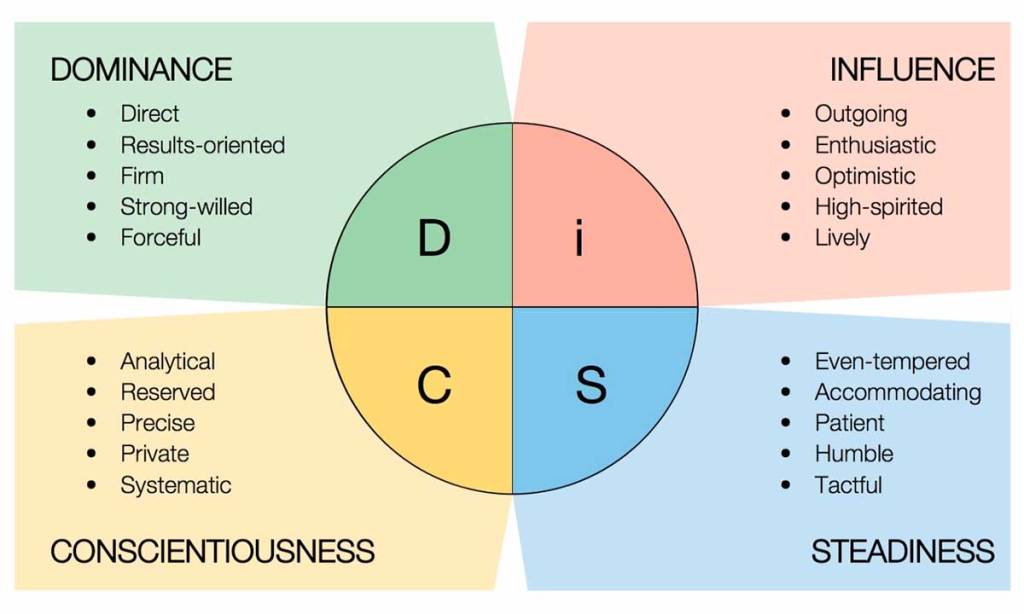
In order to accomplish this, you must know yourself and your team. That means you must understand what type of personality you are and surround yourself with a team that compliments it. A great way to do this is by taking a DISC Assessment which allow for you to find out more about who you are as an individual. There are four kinds of personalities according to the DISC, and the graphic below helps to explain each of them in a little more detail.

Most DISC Assessments require you to pay for them, but you can find a free one here. There is also a PDF version of a shorter assessment that you can download and print here. I would suggest studying up on the profiles before administering this assessment so you know how to help your leaders and yourself grow through it and use it to strengthen your program. A great resource to help you dig a little deeper into understanding what each profile means, how they interact with others, and their relationship to Biblical characters is How to Solve the People Puzzle, a great resource written by Mels Carbonell.

As you begin to understand who you are as a leader, it allows you to bring in people who compliment your strengths and empower you in your weakness by supporting you. This allows for your team to not only be able to relate to students of all personalities, but also to create a program that ministers across a wide spectrum. Having a group of people that embody multiple personality styles will make your team stronger and more capable.

Remember that there is no singular personality that is better for a youth worker. Every personality is beautiful in its own way and each personality is capable of ministering and caring for students and their people.

What is your personality and how have you seen God use that in your ministry?

Fact or Fiction: Student Ministry is a Stepping Stone

I am so excited to start this new series. Elise and I have talked at length about misconceptions, myths, and untruths when it comes to ministry as a whole. As we looked deeper into some of these thoughts, it was clear that in youth ministry especially, there are old myths that continue to exist.

As we processed these myths we began to see just how harmful they can be if believed. Like any myth or untruth, these will lead people away from student ministry and in fact do more damage to the students we are shepherding, the volunteers we are leading, and ultimately hamper us from following the calling God has placed on our lives.

Whenever we post for this series (and honestly this applies for any of our posts) we would love to dialogue with you about it. We want to hear your experiences, to tackle your questions, and wrestle with Scriptural truth together.

Today’s myth: Student ministry is a stepping stone to other ministry positions.

I remember the first time someone asked me when I was going to be a real pastor. I was serving as a youth pastor and I regularly taught and preached to our student group. I had officiated weddings and funerals. I had counseled students and adults. I had built a volunteer team and continued to pour into them. I was confused when I heard the question. So I responded with one of my own: what makes someone a real pastor?

The conversation that followed showed the biases that exist within church culture. Many people hold the belief that student ministry is simply childcare for students, and that youth pastors are “in training” to become real pastors a few years down the line.

The facts are completely different. As youth pastors we are real pastors. To assume otherwise calls into question the calling that God has placed on our lives, which in essence is calling God into question. God doesn’t call the perfect, the disciples are clear evidence of this, but He does call the ones who He needs at the right moment and at the right time.

As student pastors and youth workers we shouldn’t be constantly looking toward the next opportunity to advance. This is truly a heart issue because it shows that we ourselves are not content with the calling God has placed on our lives. Instead we should be focused on serving where God has placed us. If we are constantly thinking ahead to the next job or opportunity, we are devaluing the ministry we serve in and those within the ministry. We are basically saying it isn’t worth our full time and attention because there are bigger and better things elsewhere we are focused on.

We have all been gifted to serve in different areas. That’s the beauty of the body of Christ. No one area of ministry is greater than another. Adult ministry is not superior to children’s ministry. Care ministry isn’t greater than student ministry. Sunday mornings aren’t better than midweek programming. Ministry isn’t a competition, nor is it about personal advancement. It is all about the advancement of the Gospel and the Gospel alone.

Yes, this may not be the case where you serve. The structure of your church may highlight the view that not all ministries are equal. You may be underpaid or not paid at all. Students may be treated as less-than by other pastors or members. But you cannot allow for those things to define who you are and where you are going. Instead, focus on the calling God has placed on your life and trust Him to guide you to what comes next. Be content with where He has placed you, and don’t use it to simply move up the ranks.

There are countless studies (Barna is a great resource) that highlight the need for consistency in students’ lives and how students flourish off of continued investment by the same people. Inter-generational ministry will greatly help students grow in their faith and see that they are an integral part of the church. By staying and focusing on the ministry and students God has entrusted to you, you are valuing students and the church as a whole. Be willing to give more than just a few years, and consider giving your life for the calling God has placed upon you.

Is there a ministry myth you think we should tackle? Share it in the comments and you may see it in an upcoming post.

Our Picks: Study Bibles for Message Prep and Personal Use

When it comes to preparing messages and personally studying God’s Word, there vast amounts of resources at hand. There are commentaries, various theological resources, countless articles, websites, and more. One of our favorite resources to utilize is the study Bible. The ability to read God’s Word and have helpful and insightful information all together is a huge win.

Today we want to share with you some of our favorite study Bibles that have helped us in our own relationships with Jesus and have allowed for us to become better communicators as we seek to know God’s Word at a deeper level.

The CSB Apologetics Study Bible

This is a great resource for personal study and message prep. The CSB has quickly become one of our favorite translations of the Bible because it relies upon the best manuscripts we have on hand, and is translated in a way that is easy to understand without sacrificing truth for ease.

The Apologetics Study Bible offers more than 100 commentaries and articles on various questions, thoughts, and difficult topics. The reason this is helpful for teaching is that these articles contain many of the questions that students (and arguably all Christians) have but may not voice. It also helps us to keep our minds sharp and ready to answer questions that are voiced, and it provides resources we can share with others.

CSB Worldview Study Bible

I really like this Bible when it comes to preparing messages for our students and for our church. The purpose of this study Bible is to showcase how the truths of Scripture impact our worldview. This approach provides many practical and tangible applications for when we are teaching.

As we think about our students who are part of Gen-Z, they are always looking for ways to engage and be involved, and this resource provides just that. There are extensive notes and articles that will provide you with insight into how to apply the Bible to our lives and make our faith real and active.

ESV Study Bible

This is a must-have resource for anyone in the church, regardless of whether you are paid staff, a volunteer, or an attendee. The ESV Study Bible has an amazing set of notes and information that allow you to glean additional information that you may not have seen by simply reading the text. This is a Bible that has been put together by 95 Bible scholars from around the world with a variety of denominations contributing to it.

It also has more than 20,000 study notes, over 80,000 cross-references, more than 200 maps, helpful articles, and a concordance. This Bible will help you in so many ways as you seek to grow in your personal relationship with Jesus and as you lead others in your ministries.

NIV Zondervan Study Bible

This study Bible is a great resource that was overseen by the guidance and insight of Dr. D. A. Carson and more than 60 other contributors. Its purpose is to help readers see God’s special revelation in the Scriptures and to help readers grow in their faith.

Some of the resources in this Bible include full-color maps, charts, photos, and diagrams, study notes in the margins, introductory material for each book of the Bible, cross-references, and a concordance.

NIV Cultural Backgrounds Study Bible

This is not a Bible that I have in my personal library but one I have borrowed often from friends and colleagues. This provides so much context and insight into what was happening during the time period of the text and why it was happening in that way. When we are thinking about critically reading and analyzing Scripture it is vital that we know the context to what is taking place so we can make informed and accurate assessments and applications.

This Bible provides you with much-needed context along with verse-by-verse study notes, introductions to each book, defined terms from both Testaments, more than 300 articles discussing contextual topics, over 300 full-color photos, illustrations, and images, and various maps, charts, and diagrams. This is a great Bible to help us grow in our knowledge and understanding of what was happening in context, which will then help us shape how we apply this text to our lives and the lives of those we lead.

What Study Bibles or other resources have you found that have been helpful in your individual studies and to make you a better teacher?

Helping Students Build Lasting Friendships

Friendships and relationships. What do those words mean to you? Recently these words have taken on such new meaning considering our present context. Before COVID-19 students could engage in friendships simply by going through their daily rhythms. They saw friends at school, hung out at Starbucks, went to youth group, and could go over to one another’s homes.

Today that isn’t the case: we are being told to stay home and distance ourselves from one another. Because of this, many relationships are struggling and students are feeling it. But this begs the question, why? Why are students hurting so badly in isolation? Why are relationships struggling?

The answer lies within the context of Scripture: We were created for community. Going all the way back to the beginning in Genesis, we see that God designed humanity in His image and likeness. God is a triune God which means He desires community. But even more than being crafted in His image, God designed humankind to desire community with one another. That is why Adam and Eve were put in the garden and told to share in its duties together.

Community and relationships are things that are rooted deep within us. The desire to be with and connected to others is part of who we are. But how do we do that in our present circumstance? How can we continue to maintain friendships and relationships? And how can we help our students not simply maintain but strengthen their friendships during this time? I want to offer some helpful tips for how to do this so our students not only survive but thrive during this period of their lives.

1. Pray for your students and their friends.

Prayer is and always will be essential. But in these days, we realize the need for it so much more. Students’ lives are being challenged and up-heaved, and they are asking deep and profound questions about the nature of everything that is happening.

Let me challenge you to pray all the more for your students. Pray for their spiritual walks, for their relationships, for their witness to their peers, for their friends and their families. Be in prayer for them as the attempt to adjust to what is happening. Pray that God gives them deep and meaningful friendships. Pray for your students to have friends that reflect Jesus to them, but also that they can share Jesus with friends who don’t know Jesus. Prayer is a powerful tool, and we must be on our knees daily for our students as they navigate our ever-changing world.

2. Encourage students and parents to structure screen engagement.

Screens are more a part of our lives then they have ever been. Students are being pushed to online learning, they are connecting over social media, Zoom calls abound, and sadly this is just to manage school. What I would encourage is this: balance the time spent on screens. Don’t let it simply be one-sided. Challenge your students to have positive intake coming into their lives through the screen. Whether that is through watching sermons or youth group lessons, engaging in conversations with friends and family members, or through listening to worship music. Encourage positive inflow.

But even more than just having positive inflow, encourage students and families to create time away from screens. Have them set up intentional time to engage as a family, to play games, watch a church service together, go on walks, plant some flowers, cook dinner together, throw around a football. Building relationships within the family helps to model what this looks like in other relationships.

I would also encourage you to have your students think about calling or writing their friends. Send handwritten notes, have an actual phone call away from the screen. Moments like these may seem simple, but are actually refreshing in a screen saturated world.

3. Help students understand relationships aren’t one sided.

Friendships these days tend to be one-sided. We enter into them expecting to be filled and encouraged but we don’t often think about what we can give. Our culture dictates that we should expect to receive more than give, and unfortunately this has bled into our relationships. So help your students understand that they have to be willing to give to the relationship and not just receive. A few easy ways to challenge your students with this include:

  • Have them ask how the other person is doing, and then follow up on it at a later time.
  • Challenge them to be willing to call or reach out to the other person and not just expect to be called.
  • Push your students to keep reaching out, even if to them it doesn’t seem worth it.
  • Encourage your students to be kind and thoughtful toward their friends, and to think about the words or style of words that they use (sarcasm is no one’s friend).
  • Have students think of a tangible way they could bless one friend a week during this time and follow through on it.

4. Encourage students to be intentional.

Having good friendships and relationships take work, which means we have to be willing to engage with them. And that means we must be intentional. Friendships don’t just continue to exist if we aren’t actively engaged with them. We must be willing to be intentional and, at times, sacrifice for our friendships. Students must be challenged to be intentional in their friendships especially during this time. Simply shooting off a text, or not responding for a week, or not reaching out to people you were connected to will cause hurt and tension in relationships for both parties.

We are designed for community but we cannot simply hope that everything will be the same if we do not intentionally engage. Intentionality shows others that they have value and meaning, and it allows for the person showing it to grow as well. Challenge your students to take the first step, and the second, and third. It may not always be reciprocated, but showing intentionality will encourage and help others, and your students will see when others are doing that for them.

5. Encourage students to be transparent.

Our culture demands that we appear to have it all together, to make it appear as if our lives are perfect and nothing is wrong. Many people, our students included, struggle with this reality. But we must realize that part of friendship is a willingness to be authentic and transparent. To be willing to share how you really are doing. We must challenge our students to be who they really are in their friendships, to let them know it is okay to show vulnerability around their peers.

Transparency and authenticity are large parts of any friendship and relationship. In order for relationships to grow and trust to be formed, people must be vulnerable by being transparent. This allows others to see and know you for who you are, and to value and love you regardless of faults. Being transparent allows for trust, friendship, and growth to happen in a relationship, and if we can challenge our students to do this, we will begin to see them thrive in their friendships.

How do you encourage students to build lasting friendships?

Questions to Ask Yourself Before Volunteering in Student Ministry

In several months the school year will be over, summer ministry activities will be starting, and youth leaders will be gearing up for a new school year–which always includes the search for new volunteers. If you’ve considered jumping in as a student ministry volunteer, now is the perfect time to evaluate if this is the role for you.

It can be hard to discern where we should serve, whether we’re “called” to a particular role, or how to prioritize our ministry involvement. But these are important things to work through before stepping into student ministry. There will always be things you can learn only through involvement, but there are also essential things to ask before you get there.

Today I’m outlining a few top questions that I would encourage potential volunteers to ask themselves before jumping into student ministry. These can also be helpful questions to use as a personal evaluation for anyone already serving. If you want to use this post for evaluation purposes, I recommend answering the questions and reading only the first paragraph under each heading before you read the remaining paragraphs. This will help you evaluate your honest answers.

Ask: Why do I want to serve in student ministry?

Let’s start simple: why do you think you want to serve? Be brutally honest as you answer this question because often your motives will reveal your heart. List as many reasons for serving as you can think of.

If most of your reasons start with you–like what you want to get out of it, or what you think you can offer to students–it might be good to press pause and take a step back. In as much as you will get something out of volunteering and you might bring a lot to the table, these should be secondary, not primary motivations. Student ministry is about sacrificially serving Jesus and the students, about being there for them, showing up consistently, and having the fortitude to dig in when the going gets tough.

If you step in with self-centered motives, you will end up disappointed, and you will most likely struggle in your role. You may find yourself comparing and competing with other leaders, looking for student affirmation, and feeling rapid burn-out when you don’t get it. On the flip side, if your motives are oriented toward serving the Lord first, you will look to Him to define your success and give you strength in the hard times. And if you put the students and their needs ahead of your own, you will have a better perspective on your purpose in student ministry.

Remember: It’s not wrong to feel like God has gifted you in this area, and that you have special gifts you would like to use to serve students. Just because it may feel like a motive is selfish doesn’t mean God can’t and won’t use it. Actively seek to give your gifts and desires back to Him.

Ask: How do I honestly feel about and view students?

If you were to be completely honest on how you feel about middle school and/or high school students, what would you say? When you see them at church or out in your community, how do you view them and what do you think about them?

How you feel about students deep down will manifest itself as you serve in student ministry. If you find them annoying, obnoxious, entitled, or a lost cause, those views will eventually manifest themselves. You can’t fake it with students.

If students frustrate you, ask God to change your heart and help you see them the way He does. Allow time for God to break your heart for students before you jump in and serve. Keep in mind that if you find one age group challenging (i.e.

Remember: Even if you view students with love and respect, your heart toward them will still be tested. Student ministry can be very challenging, and there will be times you don’t want to love students. In the moments when you feel incapable of love, look to God for strength and direction. Only He can sustain you through difficult seasons.

Ask: What priority level can I give student ministry?

Some additional questions to answer include: How many ministries/extra activities am I involved in and how much time do they take? How much time am I able to commit to student ministry? On a scale of 1-10, how important is student ministry verses the other activities I’m involved in? To help you answer some of these, you might need to first talk to whoever is over the student ministry to get an idea of how much time you will need to commit each week.

The bottom line is that student ministry often requires being a top-tier priority. You will discover that it doesn’t just require a couple of hours each week. To truly invest in the lives of students, you will need to interact and spend consistent, regular time with them. This is not to say that you can’t have a life or other involvement outside of student ministry, but at times other things may need to take a back seat to your role as a youth leader.

If you commit to numerous ministries and activities, eventually one area will suffer. If you’re already serving in several large roles, it may not be a good time to get involved in student ministry. It’s important to know that more isn’t always better. Sometimes keeping your commitments minimal will help you have time, energy, and space for those who desperately need you.

Remember: Over-commitment in life is not sustainable long-term. This also includes over-commitment in student ministry. Make sure to create space in your life for spiritual in-flow outside of student ministry. This can include time with family and friends, a Bible study with peers, and regular time in prayer and the Word.

Ask: What am I hoping to get out of serving in student ministry?

In a way we touched on this in the first question, but let’s dig a little deeper. What are you hoping will be the end result of your time volunteering in student ministry? Do you have a certain vision or goal for your involvement? What are you hoping will come out of your time investing in students?

This is a way to assess your true motives, to ask the tough questions, and seek God for the answers. It’s hard to always have pure motives all of the time, but if your motives are rooted in things like affirmation, recognition, or building a brand, it may be time to do some heart work outside of student ministry.

The truth is that student ministry isn’t about any of us; it is about God, His mission, and being a willing part of what He is doing. If your hope is to see and join in what He is doing in the lives of students, then you are on a good track. Remember that at the end of it all, it won’t be about you or what you did or didn’t do (so in that, don’t worry about perceived failure), it will be about God and what He did.

Remember: If you step into student ministry and see change and growth in your own life, it doesn’t mean that you’ve made it all about you. God will use the crucible of service to refine and shape you, especially in the moments that feel like failure. If He has called you to student ministry, He will use you and He will equip you for the work. Continue seeking Him, in the triumphs and the setbacks.

Ask: What do I have to offer?

Ask this question genuinely, not pridefully. What are things unique to you that you can bring to the table? What are things you can offer to the ministry? What passions can you share with younger generations?

The truth is that God has gifted all of us for service in His kingdom, and I think we can miss what we have been given if we don’t identify it and seek to use it. It may feel awkward to list these things, but they can help you determine if student ministry is the place for you.

If you do decide to step into student ministry, look for specific areas where you can implement your skills and passions. If you love to teach or speak, look into opportunities to share with the group. If you are a musician, look into leading and teaching students. If you enjoy baking, bring sweets and treats to share with the group. If you have a passion for social justice, look for ways to empower and equip students with the same passion.

Remember: Don’t disqualify yourself for trivial reasons. If you think you’re too old, know that inter-generational relationships are crucial to the life and growth of the church. If you think you’re too out of touch, ask genuine questions and let the students teach you. If you think you’re ill-equipped, ask God to empower and embolden you. And if you feel scared, remember that students are people too, and they desperately need the love of Jesus.

If you’re still uncertain…

It may be time to set up an appointment with the pastor or student ministry leader. Be open about your desires and concerns, and let them ask you questions. They can help you discern if student ministries is the place for you. You may also be able to sit in on one or two nights of youth group to get a feel for the ministry and what you would be doing. Sometimes it takes jumping in fully and committing to a year to see if student ministry is where you feel called to serve. Remember to be honest and to be open to where God might lead you.

Help! My Students Don’t Like Me

“How do you make students like you?”

“I am a new youth pastor and I am not connecting with my kids…what am I doing wrong?”

“I have been in youth ministry for years, but I can’t seem to find common ground with my teens in my new position.”

These are just a few quotes I have heard over the past couple of weeks from youth pastors who are struggling to connect with their students.

The real question before us is this: how can I connect with, relate to, and push my students to the Gospel? Throughout various ministries, and lots of trial and error, I have seen many ways work and lots of ways fail. I want to share a few ways to help you connect with your students regardless of where you are and how long you have been there.

Don’t put your worth in students liking you.

If you find your success, identity, and validity in students liking you, then you went into the wrong field with the wrong intentions. You aren’t here to be liked–don’t get me wrong, that’s a huge plus–you are here to disciple students and point them to Jesus. Don’t go looking to be liked but go seeking to show them Jesus and love them the way He does.

Don’t expect them to come to you.

Go to where they are. I think sometimes we believe that if we keep office hours, have an “open door policy,” and invite them over then they will come. That isn’t the case. Students in fact have been told to not go hang out with strange people. If you are in a new position, you are a strange person. They don’t know you yet. They don’t know your passions and heart. So go to them. Go support them at their games and activities. Get involved in the community. Bring donuts to their school in the morning.

Know your students.

This seems like an easy one but depending on the size of your program (and if your memory, like mine, isn’t great) you may not be able to know every student. But try to get to know the ones you can and remember them. There is so much power in being called by your name instead of “hey you” or “buddy” or “dude.” Remember their names, but also seek to know more about them. What school do they go to? What activities are they engaged in? Who is in their friend group? Where’s their favorite place to go hang out? What’s the best coffee shop? What’s their favorite thing about youth group? When you know these things and bring them up in conversations you are showing intentionality and a desire to be a part of their lives.

Be real.

I cannot stress this enough. All you have to do is look at all the memes out there about youth pastors being one way around students and another in front of church members or parents to know that the common perception of youth pastors is they aren’t authentic. Maybe it is just a meme and I am trying to be too insightful, but I think the underlying truth is there: be authentic.

Students can tell when you aren’t being genuine or you’re trying to “just relate” but don’t truly care. They have plenty of people who pretend to care or invest in their lives, they don’t need another one. Be yourself! Don’t try to be someone you aren’t. If you are dorky, own it. If you are an athlete, play basketball with them. If you are quiet, don’t try to be an extrovert. And don’t pretend to know someone when you don’t. Love them as Jesus does and show them who you are.

Have fun.

Don’t be a stick in the mud. Sometimes engaging with students means having fun with them and with what they are doing. Think about it: what adult other than a youth worker do you see playing Gagaball or challenging students to an eating competition? I’ll wait while you come up with names… But seriously, have fun with your students. If they like board games, play with them. If they are into video games, brush up on your gaming skills. You don’t have to crush it or them, and when they beat you, laugh about it.

I love playing 9 Square with my students. Some of them are super athletic and can dominate the game. I can go toe-to-toe with them, but I often choose not to and allow myself to get spiked on. Why? Not because I like losing, but I love to laugh at it and also I get to connect with the students who did get spiked on. Have fun and let your hair down.

Tell personal stories.

Elise wrote an awesome post about the power of a story and she couldn’t be more correct. Stories convey truth and emotion, and they connect with people in a very real way. I love telling stories when I teach and they are almost always personal. I do this for two reasons: people see I am real and just like them, and it allows for my students to know me on a deeper level. My students know about my childhood, college years, my day-to-day activities, and all the times I messed up. In fact, I have students come up and say “remember when you did…” But the funny thing is they weren’t there for that moment, but they were there for my story. They connect with you as you allow them into your space.

Be consistent.

Don’t give up. The reality is all of this takes time and effort, and there will be moments you want to check out or walk away. Don’t! Stay invested. Keep showing up. Go to the plays and sports and coffee shops. When no one comes on a youth group night still show up. Students see you. They see your heart. Be someone who is there for and with them. Be the person they need and the person God called you to be. When you say you will be someone where, be there. When you say there is youth group, show up and be excited. Be consistent and watch what God does.


5 Ways to Improve Volunteer Communication

Let’s face it: without a team of volunteers it is exceptionally hard to run a student ministry. It gets harder still if that team doesn’t know the plan.

I have often found that a team functions best when there is a clear plan and goal because of clear communication. If I am being honest I am not always the best communicator when it comes to planning and sharing what is happening.

This is a place I am constantly looking to grow in, and as such I wanted to share with you a few ways to enhance communication with your team. I have had to learn to do these things and honestly have learned a lot through mistakes. Most of these are digital, but some are face-to-face as well because both are extremely important.

Ask your team how they communicate.

I have a questionnaire I ask my leaders to fill out (both new and returning leaders) and I ask for their preferred means of communication. This allows me to see how they communicate and be able to utilize the best forum. It also highlights any issues that may develop if someone doesn’t use a certain method. Some of my leaders only use WhatsApp and because it is only a couple of people, I make the effort to communicate with them there if I text the rest of the team.

Choose your medium and use it.

As youth workers we are forever surrounded by new and different ways of communicating. But if we continue to switch it up on our teams, they will never know where look. I had a volunteer during my first year at church who would respond to my emails via text. It wasn’t ideal because when I would be looking for information from them, I wouldn’t know where to go. I finally sat down and made it clear that the main way I communicate is email for standard youth group stuff. If it is an emergency or a day-of change it would be via text or phone.

My teams know this is the standard case, and as such they are expecting my communications via these platforms. It has helped to streamline our communication and works well for sharing information. Choose whichever way is best for you, and stick with it. If you do change it, communicate that to your team.

Be consistent.

A big thing I have learned is that when we say we are going to do something, we need to do it. Don’t promise to communicate via email and then switch to text. Doing this not only confuses leaders and doesn’t communicate well, it also creates a lack of trust in what you are doing. Be consistent, and if change needs to happen, bring your team in before you make the change.

Communicate early.

We plan out our schedule a year at a time. Typically this is during late spring and we are able to get that information out to leaders before the start of the new school year. They see when we have events, trips, retreats, and we also note when we do not have youth group. This allows our leaders to prepare for the year and know what is coming; there are no surprises.

I also make an effort to get our small group resources and plans out to leaders at least 24 hours ahead of youth group so they can prepare for the evening. I send the schedule, notes, and the questions for small groups so leaders know what is happening, what is expected, and they have the ability to mentally and spiritually prepare for the next day.

Communicate in person.

Much of what has been shared has been about digital communication, but we cannot overstate the value of face-to-face communication. Those are the moments when you get to truly shepherd and care for your people, and you get to cast vision and passion for the ministry as well. Take time to communicate clearly, answer questions, and receive feedback. We should never undervalue our leaders and must always seek to be with and for them.

Leading Small Groups: Self-Guided Discussion

There may be times as a small group leader that you don’t have pre-scripted questions, or your students aren’t vibing with the questions you have. While it may not always flow seamlessly, those are times when I like to move to what I call “self-guided discussions.” These are discussions facilitated by a small group leader, but essentially led by the needs, responses, and thoughts of the small group. Here is a basic look at how to lead your group using a self-guided discussion.

If you can, do a little pre-discussion prep.

The longer you spend with your particular small group, the more you will learn about them. You will be able to identify key areas that impact their lives individually and collectively. As you learn these things, you will be able to identify key topics or themes from weekly lessons that will be most relevant to them.

If you know the lesson topic prior to youth group, you can prep beforehand. Otherwise, you can take notes and write questions during the teaching time. Look for ways to connect the topic or key points of the lesson to the lives of your students. Come up with some questions that will lead students to make these connections on their own, rather than simply spoon-feeding them the answers.

Ask, “What stood out to you?”

If I can tell my students are engaged and thinking through to the topic, I want to hear what is standing out to them. Often I like to ask this question first to see what spoke to them, what they are thinking about, and what they might need to spend extra time talking through. Sometimes this will dictate the entire direction of our discussion time, especially if it is a topic I know will benefit the entire group.

When asking this question, you may get answers (or comments) that don’t exactly relate to the lesson topic. Sometimes your students might go entirely off topic. If it’s something worth talking about, I would encourage you not to completely shut down the discussion. Some of the best conversations I’ve had with my small group originated from what seemed like a tangent. It’s okay to deviate from the intended topic and let conversation grow organically as long as it’s beneficial and not an attempt to distract the group. This can be one of the best aspects of self-guided discussion.

Ask follow-up questions based on students’ answers.

After asking the students what stood out to them, use their answers to guide your questions. Pick a key word or topic from their answers to hone in on. Ask follow-up questions that will steer the conversation in a helpful direction. This is a great way to help students connect broad topics to real-life application. It also allows you to spend more time on things that are important to your students, rather than glossing over them to move on to the next question.

Apply questions and answers to specific life circumstances or issues.

As I mentioned before, it’s important for us to assist students in connecting the truths of Scripture to their lives. They need to be able to see the relevance of lesson topics for their lives. These connections may be easy for them to make, but other times they may struggle. This is where you as a leader can guide them into making these connections with the questions you ask. The more you know about your students, the more you will be able to connect topics to their specific life circumstances.

Within this, it is important not to disclose things you have been told in confidence by students. Use discretion in how you address topics, keeping student privacy in mind. If a student has shared an issue previously with the group at large, I recommend speaking to them privately before bringing it up again in the group. This can be as simple as pulling them aside and asking for their permission to bring up the topic, or asking them if they would be willing to share about it.

Encourage your students to ask questions.

Self-guided discussion truly becomes self-guided when your students start asking questions. This may start with them asking you things, but eventually they will hopefully begin to ask each other follow-up questions. Even if you don’t know the answer to a student’s question, encourage them by affirming their question, and if needed, doing some research so you can follow-up with an answer. Be honest and open with your students. You don’t have to share everything, but you will be able to connect with them on a deeper level if you let them into your life. This will help to build rapport between you and your students.