Our Picks: Must-Have Books [Part 2]

Last week we kicked off a new “Our Picks” installment as we looked at books that have been helpful during our time in ministry. These books might not directly relate to student ministry, but they are extremely helpful to ministry overall. Today, I want to share part two of this series, and I hope that these are as helpful for you as they are for me.

Preventing Suicide: A Handbook for Pastors, Chaplains, and Pastoral Counselors

Karen Mason writes a powerful book about suicide, myths about suicide, triggers and causes, and helpful steps to prevent it. I truly believe that this book is necessary for anyone in ministry but especially for those working with students. Students are wrestling with multiple issues including depression, anxiety, image, and identity that all cause them to grapple with “am I enough” and “do I have value.” This book will help to equip you to step into those moments when students need you the most and help them. Another helpful part of this book is that it provides resources for helping survivors of attempted suicide, families, other lay people, and the community of which you are a part.

The Bullying Breakthrough: Real Help for Parents and Teachers of the Bullied, Bystanders, and Bullies

Jonathan McKee just released this book in 2018 and I had the privilege of reading an advance copy, and cannot recommend it enough. The Bullying Breakthrough provides the reader with firsthand accounts of bullying as well as ways to minister to all parties. Jonathan truly approaches this from a holistic scope and offers readers ten tools to help bullied kids and seven tools to help schools. Jonathan writes from the heart as he experienced bullying and he seeks to unearth the root of the issue so it can be treated appropriately. This book provides you with insight into physical bullying, cyber-bullying, helpful practices, and resources and steps that you and your community can take to combat this issue among students.

Understanding Your Teen: Shaping Their Character, Facing Their Realities

This is a helpful resource for you to have on hand for parents. Jim Burns is one of the foremost authors and speakers on youth and families, and this book is a helpful guide for parents. Dr. Burns offers insight into how to help shape behavior and character, how to navigate social media, conflict resolution, and much more. Dr. Burns’ book is vital to parents who are attempting to shepherd and disciple their student(s) well, and it is also applicable for pastors and leaders of students as it provides insight and knowledge that will make you a better shepherd. Burns not only highlights the issues and pressures facing students but also gives practical tools and insight into how to care for and walk with students.

99 Thoughts for Parents of Teenagers: The Truth on Raising Teenagers from Parents Who have Been There

Walt Mueller is more than a friend, he is a noted author, speaker, and trust source on all things related to youth and families. His ministry is one of the best out there, and I would highly recommend any and all of his resources. This book is designed in an easy to read format of 99 thoughts to help parents succeed. Literally, most of these thoughts are no more than a paragraph but they are designed to offer helpful truths in a soundbite sort of way. This book would be an awesome idea to bless parents with at a parents meeting or at a training event.

Living in a Gray World: A Christian Teen’s Guide to Understanding Homosexuality

Preston Sprinkle is one of the top scholars in this particular area of study, and his book is one of the best out there. It is an easy read and it provides solid insight and Biblical truth. Preston approaches this topic with heart, tact, and a listening ear and is quickly becoming one of my favorite authors and speakers. His insight into this topic and how to minister as a whole to the LGBTQ+ community has helped shape how I have approached these topics in my ministry and the church in which I serve. This is a must-have for any youth worker.

Our Picks: Must-Have Books [Part 1]

One of the things I love about what I do is the opportunity to read, process, and apply books to what I am doing as a student pastor. Today, I want to share with you some must-have books that I have found exceptionally helpful in ministry. They are not all youth ministry focused, but they do have a tangible application to what we do as youth leaders. I will highlight why I believe each book is helpful in the description and provide a link for you to check them all out as well.

The Quick-Reference Guide to Counseling Teenagers & The Quick Reference Guide to Biblical Counseling

These are both solid resources written by Christian doctors who are seeking to help pastors and youth workers process the information related to a variety of counseling issues. It provides typical symptoms and patterns, definitions, key thoughts to help you process what the student is feeling, questions to ask, action steps, biblical insights, prayer starters, and much more. These books are not simply focused on a “read your Bible and pray to get better” methodology, but rather they utilize Biblical truth and application with science and medicine. These have been exceptionally helpful in a variety of circumstances.

A Good Commentary Set

I specifically didn’t list one in the topical heading because there are way too many to think through and honestly, we will all find ones we appreciate more than others because of our denominational preference, upbringing, current context, and theological preferences. With that being said, we must acknowledge we will never fully agree with everything a single commentary says. There are a couple of solid commentary sets that I personally have found helpful and would recommend. Walvoord and Zuck’s two volume set is exceptionally helpful and breaks down the text in an easy-to-understand way that anyone can read and use to help shape their messages or to answer questions people may have. Another helpful option is the NIV Application Commentary Set. This is a larger set and significantly more expensive, but it is worth it. The information is very helpful and it is written in an easy-to-understand format. This is a commentary set that will help you in crafting messages and help you grow in your own knowledge and understanding of the Biblical text.

The Pastor’s Handbook (NIV)

As I have progressed in my ministry career I have had the honor and privilege of officiating many different ceremonies. I have led weddings and funerals, handled baptisms, officiated communion, and been a part of anointing ceremonies. Some of these I felt my ministry training had prepared me for, but during others I felt completely ill-equipped. This pocket-sized resource provides you with various outlines and order of services for a variety of settings and is completely malleable to however you want to shape the ceremony you are officiating. It provides everything from Scripture suggestions, to outlines, to helpful tips and timing thoughts. This is a must-have for any minister.

How We Got the Bible

This is an excellent resource by Timothy Paul Jones because it answers many of the questions that students and adults are asking about the Bible. Where did it come from? How do we know we have it all? Are the texts reliable? Why do we have some books included but not others? These questions and more are answered in this easy-to-read and compact book. It includes dates, helpful charts, and exceptional appendices.

How to Solve the People Puzzle: Understanding Personality Patterns

I know there is a lot of excitement surrounding the Enneagram, but I love the DISC Assessment as it relates to personalities and interpersonal relationships. Working with students and volunteers (and churches overall), this is a helpful resource to understand your personality, the personalities of those around you, and how to best work together. Carbonell provides resources for each personality that include how you act in various situations, how you react when you are stressed or emotions are heightened, how you engage with other personalities, and much more. I use this resource whenever I lead mission trips and walk my teams through it to help them understand how to engage with each other during those intense moments. It is a must-have for any youth (and church) worker.

Next week we will share more books that have been helpful to us, but we would love to hear which books you have found helpful in your ministry setting.

Fact or Fiction: Bigger Programs = Better Programs

Have you ever gone to a conference and seen all the cool stage designs and heard about youth groups with hundreds or thousands of students and longed for those things? Have you ever wished your program was as big as the others in your town? Have you ever wished that you’d have more than just the few faithful students come to youth group?

These desires and feelings can lead us down a dangerous path. We can begin to question our calling and effectiveness, we can covet and lust after other programs or churches, and eventually we can lose focus on our mission and forsake our students and church because of our longings and desires.

These feelings aren’t inherently bad or problematic, but prolonged focus and frustration can lead us to a dark place. But we must understand that the size of our program does not reflect the transformative power of the Gospel nor does it translate into how effective you are at serving.

Today’s myth is, “a bigger program equals a better program.” In tackling this myth there are some truths that we must acknowledge. In acknowledging these truths, it allows us to discern our own hearts and the stability and sustainability of our program.

The size of a ministry does not represent spiritual growth.

Too often we can look at neighboring programs or ones in social media groups and wrestle with the notion that our own program is not where it needs to be. That couldn’t be further from the truth. Just because a program is large in number does not mean that the spiritual growth is equally as great. It may be, but it also may not be. What we must understand is that size does not always indicate success. We are after heart change and development. Be willing to help students develop in their faith and grow in a meaningful relationship with Jesus. In doing so you will help develop students who desire to not only grow in their own faith but are also passionate about seeing their friends follow Jesus.

The size of your budget isn’t a hindrance to growth.

I have been in many circumstances where I have had a very limited budget or none at all, and still been expected to run an amazing student ministry. Here is the thing: often times we focus on what we don’t have rather than what we do. God has called each of us to serve Him by serving students and their families. He called the disciples and told them to go out to towns with only what they had with them. He didn’t tell them to build a budget or raise money, instead He told them to go and do the ministry of the Gospel. As disciple-makers we cannot simply focus on the budget we do or do not have, but instead should focus on meeting students where they are and engaging them with the Gospel. Focus on relationships not finances. Be willing to listen instead of having your own youth center. Love and care for students instead having all the glitz and glam. Students will quickly forget the fancy setups, but they will forever remember the intentional relationships that you forged with them.

People over programs.

I think there are times we can get focused on building a bigger and better program or ministry and forget the people. And often times this happens in my life when I see things we do not have in our ministry but others do. When we simply focus on the program we miss our people. We forget that our students are real people with real life issues who need real adults in their lives who care for them. I am not saying we will dismiss and wholeheartedly forget about our students, but instead they become second to the program. We cannot allow that to happen and instead must focus on them over everything else.

Small numbers do not represent small growth.

Jesus had twelve guys He invested in. Twelve guys that eventually went down to eleven when one walked away and turned on Him. Sure, Jesus at times had thousands come to hear Him speak, but His real “youth group” was only twelve people. Think about that for a moment. Jesus intentionally built a ministry that would change the world and explode in numbers that no one could have imagined and He did it through twelve ordinary guys. In many ways, small youth programs can represent greater growth because you are afforded a greater opportunity to do life-on-life with students and help them become the Gospel centered disciple-makers that they were meant to be.

Be generous with what you do have.

You may read this point and think, “I don’t have anything to be generous with.” But think beyond the physical items you have. Remember what you do have: your time, your heart, and your passion for Jesus. You can be generous with your time by showing up at students’ events and cheering them on. Be generous with your heart and love students, especially the ones other people simply dismiss. Be generous with your passion for Jesus by allowing that to overflow into all your relationships. If you do have physical items like sports equipment, 9 Square, supplies for Minute to Win it, or various other items, be generous with those things. Be willing to share your resources with other ministries, step in and be willing to allow schools and community programs to borrow your supplies. God has gifted you with many ways to be generous, the questions is how will you do this?

Fact or Fiction: You Need Kids of Your Own to be Effective in Youth Ministry

“How do you think you’ll be able to lead and shepherd our kids if you don’t have any?”

That question shocked me. It was during a meet-and-greet with parents from the student ministry program, and honestly I wasn’t prepared for it. What that parent didn’t know is that Elise and I want to be parents but have been dealing with infertility for a long time. That comment hurt and is still an active memory, but I understand that comment wasn’t focused on our infertility but an age-old myth about youth pastors.

Today’s myth is, “You must have your own kids to be an effective youth pastor/worker.”

The truth is that having kids of your own doesn’t make you a better pastor. Similarly, if a pastor has children who reject Jesus, that doesn’t make them ineffective because their kids turned away. Anyone can be an effective youth pastor if that is where God has called them. But I do believe that for those of us without our own children (and arguably even those with children) there are things we should be doing to help us grow and minister to the students under our care.

Be a student of culture.

Let’s be honest: culture can be confusing. And not just for us, but for our students as well. That means we need to be studying what culture is saying to our students. We should be listening to what they are listening to and dissecting what they are being told. Watch what they are watching and see the messages that are being passed to them. Observe advertising and what is being peddled as “in style.” Use all of these things to understand what is happening and what your students are being taught.

A couple of great resources for studying culture include CPYU, The Source 4 YM, and The Source 4 Parents. These websites offer different critiques and viewpoints of popular music, movies, and games, as well as helpful resources designed to help you succeed by knowing in what your students are engaged. An added bonus is they give you practical ways to minister to students and families as well.

Listen well.

Students today desire people who not only spend time with them, but listen to them. Students want to have leaders who care and love them enough to actually listen when others do not. And as you listen to them, you will learn more about them: what they like and don’t like, the new slang, the popular shows they are watching, what social media platform is most utilized, and the list goes on. Being an effective youth leader means you are listening and growing as you listen.

Engage with students.

This is huge in our line of work, and can be missed even if you do have kids of your own. In order to understand and minister to students, you must be engaged with them. Go to their plays, concerts, and sporting events. Support them in their endeavors. Visit them at their jobs. Being present with your students physically is huge, but it is not the only way you engage with them.

Be willing to engage with them at a spiritual and emotional level as well. Listen when they speak. Make eye contact with them. Ask follow up questions. Challenge them. Encourage them toward Jesus. And always keep your word. Doing this not only values them, it allows for you to connect with them at a deeper level. It also gives you insight and wisdom in how to walk with them during these formative years.

Be a life-long learner.

Things change constantly and we must be willing to grow and adapt as well. Gone are the days of the 90s youth pastor. Students now value genuine interpersonal relationships with people who truly love and care about them. That means we must be willing to change as the world changes. No, we do not change or flex on the value of God’s Word and the truth of it, but we do adapt to how we do ministry and engage with our students. That means that you must be willing to continue to learn and grow as an individual and a shepherd.

The easy way is to sit back and think you have it all figured out because you have done this for years on end, you have had a successful program, or you have the right speaking chops. But the truth is that once we have convinced ourselves we have it all figured out, we have actually become replaceable and irrelevant. And I would actually assert that if any of us were to get to that point, we should step away from ministry and reassess why we are in it. See, the truth behind those thoughts is that everything about the ministry and calling God has placed on your life is all something you have done. That is why we stop learning and growing. We must remember that everything we have is a gift from God and as such we should continue to seek after Him and His wisdom. This then empowers us to continue to minister and care for our people as we continue to grow and mature as we seek God’s direction. So be a life-long learner who seeks to grow and share their knowledge and heart for Jesus.

Stand in the gap.

To be an effective youth leader, regardless of whether or not you have kids of your own, you need to be willing to stand in the gap. Often that means responding to a text or message when it isn’t convenient. It means being willing to listen and administer care when others can’t or won’t. It means showing up when you say you will show up. Just because you may not have kids of your own doesn’t mean you cannot be someone who wades into the mess with your students. In many ways you are able to do so even more. So continue to be someone who is willing to walk through the hard, and care deeply for your students as you show them Jesus.

Not having kids doesn’t mean you are not qualified. Not having kids doesn’t mean you can’t serve students. Having kids is not a qualifier for ministry. And if we are perfectly honest, all the students under your care, past, present, and future, they are your kids. The kids you give your heart to, the kids you have cried with and for, and the kids who may never say thank you but have a relationship with Jesus because of your faithfulness. So if you are one of the many youth workers faithfully giving of themselves who do not have kids, be encouraged because God can, is, and will use you to minister to the youth of this generation and generations to come.

Fact or Fiction: Extrovert or Nothing

Last week we started our new series called Fact or Fiction. This series is designed to take a look at the myths that exist about student ministry and compare them to the truth about what we do.

Today we will be looking at the myth “You must be an extrovert to be in youth ministry.”

It seems like there are always extroverted youth pastors and youth leaders. Whether it is at your actual program, or in online groups, or at the conference where everyone and their brother seems to be competing for who is the most boisterous, or in the videos you see as you scroll through social media.

The truth is this: extroverts aren’t the only people who are youth pastors and leaders, and just because some may be the loudest and draw the most attention doesn’t mean they are the most effective.

I am not sure who started this myth or when it started, but it is very similar to the myth that youth ministry is a young person’s game. I have had multiple people tell me I am not the typical youth pastor because I am not loud or crazy. But the truth is, most youth pastors aren’t. Sure, we have some who love to go nuts (in a safe way of course) with their students, but gone are the days where we used to pull students in tarps behind cars, push them down the cabin steps on mattresses, or dare them to do a Polar Bear Plunge at winter camp. And just because those memories may speak the loudest doesn’t mean there weren’t hundreds or thousands of other youth workers ministering in a quiet and gentle way.

Growing up I had all different types of youth pastors and youth leaders. I had the crazy loud ones, I had the ones who were awesome small group leaders, and I had the ones who were only there to have fun. But I still remember each of them, and they all played a role in my life and my story. There is not a one-type-fits-all youth worker. In fact, youth ministry (and every ministry) needs and deserves people with all different types of personalities.

Our students are not all the same. They are not all uniquely extroverts or introverts. If your youth group is anything like mine, you probably have a mix of personalities and relational styles. And that is a good thing! We should be looking for that in our youth groups because we want them to be a place where everyone feels welcomed and loved as they experience the Gospel. But in order to accomplish that, we must be seeking to minister to all personalities which means we need to have all personalities represented on our leadership teams.

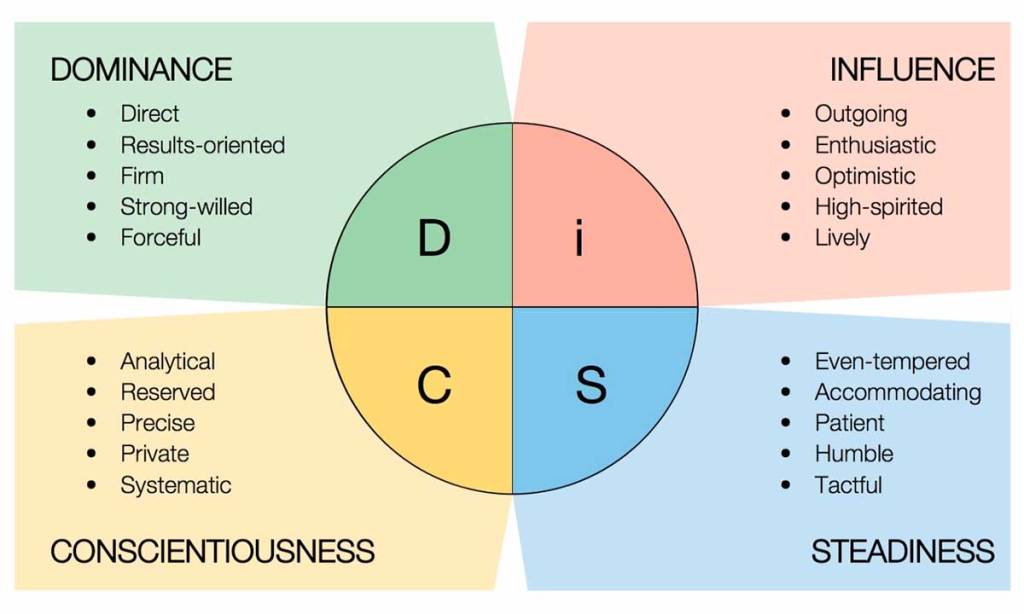
In order to accomplish this, you must know yourself and your team. That means you must understand what type of personality you are and surround yourself with a team that compliments it. A great way to do this is by taking a DISC Assessment which allow for you to find out more about who you are as an individual. There are four kinds of personalities according to the DISC, and the graphic below helps to explain each of them in a little more detail.

Most DISC Assessments require you to pay for them, but you can find a free one here. There is also a PDF version of a shorter assessment that you can download and print here. I would suggest studying up on the profiles before administering this assessment so you know how to help your leaders and yourself grow through it and use it to strengthen your program. A great resource to help you dig a little deeper into understanding what each profile means, how they interact with others, and their relationship to Biblical characters is How to Solve the People Puzzle, a great resource written by Mels Carbonell.

As you begin to understand who you are as a leader, it allows you to bring in people who compliment your strengths and empower you in your weakness by supporting you. This allows for your team to not only be able to relate to students of all personalities, but also to create a program that ministers across a wide spectrum. Having a group of people that embody multiple personality styles will make your team stronger and more capable.

Remember that there is no singular personality that is better for a youth worker. Every personality is beautiful in its own way and each personality is capable of ministering and caring for students and their people.

What is your personality and how have you seen God use that in your ministry?

Fact or Fiction: Student Ministry is a Stepping Stone

I am so excited to start this new series. Elise and I have talked at length about misconceptions, myths, and untruths when it comes to ministry as a whole. As we looked deeper into some of these thoughts, it was clear that in youth ministry especially, there are old myths that continue to exist.

As we processed these myths we began to see just how harmful they can be if believed. Like any myth or untruth, these will lead people away from student ministry and in fact do more damage to the students we are shepherding, the volunteers we are leading, and ultimately hamper us from following the calling God has placed on our lives.

Whenever we post for this series (and honestly this applies for any of our posts) we would love to dialogue with you about it. We want to hear your experiences, to tackle your questions, and wrestle with Scriptural truth together.

Today’s myth: Student ministry is a stepping stone to other ministry positions.

I remember the first time someone asked me when I was going to be a real pastor. I was serving as a youth pastor and I regularly taught and preached to our student group. I had officiated weddings and funerals. I had counseled students and adults. I had built a volunteer team and continued to pour into them. I was confused when I heard the question. So I responded with one of my own: what makes someone a real pastor?

The conversation that followed showed the biases that exist within church culture. Many people hold the belief that student ministry is simply childcare for students, and that youth pastors are “in training” to become real pastors a few years down the line.

The facts are completely different. As youth pastors we are real pastors. To assume otherwise calls into question the calling that God has placed on our lives, which in essence is calling God into question. God doesn’t call the perfect, the disciples are clear evidence of this, but He does call the ones who He needs at the right moment and at the right time.

As student pastors and youth workers we shouldn’t be constantly looking toward the next opportunity to advance. This is truly a heart issue because it shows that we ourselves are not content with the calling God has placed on our lives. Instead we should be focused on serving where God has placed us. If we are constantly thinking ahead to the next job or opportunity, we are devaluing the ministry we serve in and those within the ministry. We are basically saying it isn’t worth our full time and attention because there are bigger and better things elsewhere we are focused on.

We have all been gifted to serve in different areas. That’s the beauty of the body of Christ. No one area of ministry is greater than another. Adult ministry is not superior to children’s ministry. Care ministry isn’t greater than student ministry. Sunday mornings aren’t better than midweek programming. Ministry isn’t a competition, nor is it about personal advancement. It is all about the advancement of the Gospel and the Gospel alone.

Yes, this may not be the case where you serve. The structure of your church may highlight the view that not all ministries are equal. You may be underpaid or not paid at all. Students may be treated as less-than by other pastors or members. But you cannot allow for those things to define who you are and where you are going. Instead, focus on the calling God has placed on your life and trust Him to guide you to what comes next. Be content with where He has placed you, and don’t use it to simply move up the ranks.

There are countless studies (Barna is a great resource) that highlight the need for consistency in students’ lives and how students flourish off of continued investment by the same people. Inter-generational ministry will greatly help students grow in their faith and see that they are an integral part of the church. By staying and focusing on the ministry and students God has entrusted to you, you are valuing students and the church as a whole. Be willing to give more than just a few years, and consider giving your life for the calling God has placed upon you.

Is there a ministry myth you think we should tackle? Share it in the comments and you may see it in an upcoming post.

Small Group Game Ideas

Last week we looked at socially distanced games for groups that can gather in larger numbers. These games can work for some ministries, but other youth groups have made the switch to meeting in smaller groups to accommodate state and federal guidelines.

With that being said, I would like to share some game ideas for smaller groups. Some of these are the same as last week because they can also be played in small groups with minor tweaking. This isn’t an all encompassing list, but merely an attempt to share some resources that we have found to be helpful and beneficial.

Zoom Games

The reality for many of our groups is that we will be meeting virtually at some point this coming semester. We don’t like to think that way, but it is better to be prepared for it than not. So I would encourage you to think through different Zoom Games that you can play. An easy option is utilizing PowerPoint style games that you can screen-share with a group. Another option is doing trivia over Zoom or a “Would You Rather” style game. The cool thing with all of these ideas is you don’t necessarily need to come up with them. Download Youth Ministry has an entire section on their website where you can purchase these games and many more. I would encourage you to start building up your resources now to prepare for the fall. And if you don’t end up meeting online, these games can transition easily to in-person gatherings as well.

Charades

Who doesn’t love a classic game of charades? The general idea is that you will have someone acting out an action, character, or activity that they have pulled from a hat. These can be pre-made by you and your volunteers or you can have students submit suggestions. There are lots of different ways to play Charades like as small groups guessing, or as a large group guessing, or even reverse charades where one person guesses while the whole group acts it out. Whichever one you choose, make sure to remind the people acting out that they can not make noise or they forfeit that round.

Apples to Apples

This is a classic party game and is fantastic for small groups. It does require you to purchase the card game, but it will provide lasting fun for your group. There are also many different editions that you can choose from depending on what your group will enjoy more.

The premise of the game is this: The judge picks a green apple card from the top of the stack, reads the word aloud, and places it face up on the table. Players (except the judge) quickly choose the red apple card from their hand that is best described by the word on the green apple card played by the judge. Players place these red apple cards face down on the table. The judge mixes the red apple cards so no one knows who played which card. The judge turns over each red apple card, reads it aloud, and then selects the one he or she thinks is best described by the word on the green apple card. The player of the selected red apple card is awarded the green apple card played by the judge.

Yard Games

Being able to gather outdoors while the weather is nice is a huge blessing in many ways. Games outdoors are a huge win and don’t need to be planned out in great detail because many of them can run themselves. Some great yard games include cornhole/bags, ladder ball, giant Jenga, badminton, socially distanced volleyball or basketball, Kan Jam, Frisbee, horseshoes, or Spikeball. All of these options allow for social distancing and a ton of fun.

Heads Up

If you are not familiar with Heads Up, you need to download it now and play it. It is a ton of fun and guaranteed to get your group laughing. Heads Up is an app that you can download, but it does cost money. However, there are multiple free versions that you can download as well including the Charades App, Guess Word! Fun Group Games, Charades – Heads Up, and Charades! Kids. I would just encourage you to try them out prior to the night-of.

The way this game works is someone holds the phone up to their head while the app is running and a random word or words will pop up on the screen. The guesser will need to guess the word(s) by the clues that the audience gives. Most apps will let you know how many you get right, and you can have a friendly competition among your group.

Costume Challenge

This is an activity that can be done both in-person and online. I have had many of my leaders host online costume parties, and they change the theme each week to make them more fun and engaging. You can also do this in person, and if you have to wear masks you could even see about having students tie the masks into their costumes.

Scavenger Hunts

Doing scavenger hunts is a really easy and fun way to get students involved and moving, and they can be done in person or digitally. If you are meeting at a home, you could give a list of objects and tasks to your small group to find or complete around the home and/or neighborhood. If you are doing it digitally, you could have them find different items around their house and the first to show it on screen wins the round. Last week we shared about a great website/app called Scavr that allows you to create scavenger hunts that utilize the app and all that data and points are accumulated through an online leader board.

Users must download the app and sign up in order to participate. They then create a team name and will be able to see the challenges that you have put into the game. The beauty of this app is that it tallies the results and shows a leader board throughout the event. It removes the headache of trying to create and tally everything on your own, and makes it really easy.

Trivia

Who doesn’t love a good trivia night? You can set this up for small groups or for individuals to compete. If you Google trivia questions, there are countless websites for you to choose from or you can pop on over to DYM and find a ton of games that you can plug and play for your group.

Message Bingo

This has recently been making the rounds in various online groups, but the overall gist is that you create a Bingo board with different things that will pop up throughout the message or the night. You can add squares like “the pastor said ‘umm'” or “everyone wore a mask” or “pop culture reference” or “bad joke by pastor.” You can have as much fun with this as possible, and you could even offer prizes as well. There are lots of online generators for Bingo cards, but this website offers up to 30 free printable cards that you can change the layout and design on.

The Hat Game

This is a really fun game to play with any size group, but in smaller groups you can play multiple rounds. The premise is fairly simple: there are three rounds of game-play and two teams. In the first round one player will draw pieces of paper out the hat and try to get their team members to guess what is written on them by only using Charades. The next round is the player tries to have their team guess using Pictionary, and the final round they can speak but not say the word or what it sounds like. Each round is timed and then you rotate teams.

The fun part about this game is you can switch up the categories, the method for sharing clues, the timing, and much more. It is a game you could continue to use no matter the circumstance, and each time it will be an entirely different game for your group. For more ideas and a more complete set of instructions, check out this website.

Xbox/Wii/Switch Games

I am not normally one to encourage playing video games, especially during youth group time. But there are games on Kinect, Wii and Wii U, and Nintendo Switch that are great group games to play because they are somewhat active and allow for four or more people to play. I will say this though: be cautious with what games you choose and make sure that they are games parents and your ministry approve of. You never want an activity to become a stumbling block.

Would You Rather

These are great conversation starters and allow for you to actively engage your students with both fun and serious questions. I would suggest setting ground rules for your group that include no making fun of someone’s answer, no course or crude joking, and always answer honestly. A couple of websites that I enjoy using include Conversation Starters World and Icebreaker Ideas. Both of them have solid ideas for questions with a broad range of topics and age ranges.

Highs and Lows

If you aren’t familiar with this idea, it is a great way to begin conversations within a small group. Many of my leaders use this each week because it gets students talking and engaging with the group. It can look different depending on your group and its dynamic, but the basic functionality is this: each student and leader will share anywhere from 1-3 high moments from the week and 1-3 low moments from the week. They can be funny or serious and they can lead to some fantastic laughs and amazing deep conversations.

House Party

House Party is an app that allows you to video chat and play games with your group. I would recommend utilizing the privacy settings and make your room locked so only certain participants are allowed in. But with this app you can play different games together as a group and video chat at the same time. It is very similar to Zoom but doesn’t require screen sharing for games. Everyone will need to create an account and have the app downloaded in order for this to work for your group. So make sure your students know to do that ahead of time.

House Party gives you different game options like Heads Up, Uno, Trivia, Quick Draw, and much more. It is worth downloading and giving it a test run before you implement this with your group so you know its inner workings and limitations.

What are some of your favorite small group games?

Socially Distanced Game Ideas

As many of us are looking at returning to some sort of programming soon, it is important to critically think through what activities and games we will be hosting. Because let’s face it, most of our games are not about social distancing. In order to provide a safe place for students and volunteers, it is important to think about what games will provide the most fun while still being safe.

The games below can be shaped to fit any style or size of youth ministry, but they are primarily for whole youth groups that are regathering. Next week, I will share some game and activity ideas for small groups as many youth ministries are moving toward that direction of ministry going forward. Before we get into the actual games, I wanted to share a few quick tips to make these games successful and safe.

  • Smile and have fun. The more excitement and fun you have, the more engaged your group will be.
  • Encourage social distancing. You don’t have to be an enforcer, but helpful and kind reminders will go a long way.
  • Provide hand sanitizer stations. If kids are touching one another or communal objects, have these areas for immediately after.
  • Encourage hand washing. Even with hand sanitizer, it is beneficial to wash often after activities and before eating.
  • Remind everyone about the rules. Whatever rules your state and church are following, make sure to encourage adherence to them for everyone’s safety.

Scavr

Scavr is a great new resource for creating scavenger hunts that are hosted through an online platform. Users must download the app and sign up in order to participate. They then create a team name and will be able to see the challenges that you have put into the game. The beauty of this app is that it tallies the results and shows a leader board throughout the event. It removes the headache of trying to create and tally everything on your own, and makes it really easy.

A scavenger hunt is also a great activity to socially distance in because you can send out small groups and ask them to maintain the six foot rule, which will be easier to follow in small groups. Just keep that in mind as you create the challenges (i.e. no human pyramids, which equals less people getting hurt).

The Floor is Lava

This is an old school game that has been having a recent resurgence. If you aren’t familiar with the rules the game is fairly simple: do not touch the ground or you are out. The object of the game can vary from completing tasks like collecting objects or moving a team to a safe zone, to completing an obstacle course, to a last person standing challenge. The game can be as creative as you can imagine and will allow for various people to play but also socially distance.

Up Front Games

Depending on the size of your group and the rules you need to follow these may have to be your go-to activity for the time being. These types of games could be trivia style, rap battles, PowerPoint games, or any of a number of Jimmy Fallon-inspired games. These can be done with as few or as many people as you would like, and they can be done in a safe manner as well.

Seated Basketball/Soccer/Football

This is a personal favorite of mine. These games take the traditional sports we love and turn them on their heads. You do not have to be super athletic to play these games because you are seated the entire time. Before you start the game, set up your playing area whether it is indoors or outdoors. Simply place chairs where players will sit the entire game or period and label which team they are for. Then have your students pick a chair and get ready to laugh.

The rules are the same for whatever the game is with one addition: students cannot move from their chair. Have leaders roaming to place the balls back in play when needed. You can also change up the rules and objectives to add another layer to the games as well.

Trivia Games

Who doesn’t love a good trivia night? You can set this up for small groups or for individuals to compete. If you Google trivia questions there are countless websites for you to choose from or you can pop on over to DYM and find a ton of games that you can plug and play for your group.

Hula Hoop Volleyball

This is an easy game to set up and run with. Simply set up a volleyball net, or something in place of it like a sheet on clothesline, and then place hula hoops on each side that are six feet apart. The rules for volleyball don’t change, except that students may not leave their hula hoop during the game unless it is to rotate spots during a change in servers.

Scattergories

This is a great game to play as a small or large group. If you are playing as a small group give everyone a score sheet and have them all compete against one another. You or a leader will assign a letter and have the students write words beginning with it.

If you have a larger group, consider setting this up tournament style. Have students all compete with same letter and then when time is up they will compete only against the other person at their table. The winner will advance to the next table, while the loser stays at the table. If there is a tie have them play Rock, Paper, Scissors to decide the victor. The person with the most wins at the end is the champion.

Cornhole/Bags Tournament

If you do not have a couple sets of these for your youth ministry, let me highly encourage you to get some. I have purchased these before and they have held up very nicely. The very nature of the game allows for socially distanced fun, and you can turn it into a tournament to decide who is the best cornhole player. You can also set up varying degrees of game play (i.e. closer or farther away) to make it more of a challenge for your students.

Charades

Who doesn’t love a classic game of charades? The general idea is that you will have someone acting out an action, character, or activity that they have pulled from a hat. These can be pre-made by you and your volunteers or you can have students submit them. There are lots of different ways to play Charades like as small groups guessing, or as a large group guessing, or even reverse charades where one person guesses while the whole group acts it out. Whichever one you choose, make sure to remind the people acting out that they can not make noise or they forfeit that round.

Pool Noodle Tag

This is a game that will require a little more prep but can be a lot of fun. The premise is you are playing tag, but the only way you can tag someone is with a pool noodle. Make sure you have ones that are close to six feet long and explain to your group that they must hold it at the back end and reach out the pool noodle to tag the other players. It may be helpful to demonstrate proper tagging, especially if you have some overly zealous young men like I do who like to swing the noodles as weapons.

Nerf Battle

I don’t know if your students are like mine, but mine love a good old fashioned Nerf Battle. Having it now will look different, but it is still a viable option. You can set rules to include being six feet apart and if you get too close, you are out or need to re-spawn. I would encourage not swapping weapons unless they are wiped down, and always have eye protection. This would actually be a great game to encourage using face shields in because there will be minimal push back (and eye protection).

What games are you doing as your youth group regathers?

How to Connect with Difficult Students

The truth is we have all had a student, or students, that have been difficult in our ministry. There have been students who have tried our patience, they have disrupted teaching time and small groups, they may have broken things, or they never follow the rules.

Sometimes our propensity can be to get upset with or about them. We start to think they don’t care about others or maybe their home lives are bad and that’s why they lash out. Or perhaps we may try to connect but we have gotten tired when there is no response… or at least the response we want.

Students who get classified as difficult or disruptive are often the students who desperately need to be cared for. There are times we may feel like we are not getting through to them, but we must continue to pursue them and love them. Ministry was never meant to be easy, and Jesus came for all people especially those society would rather have forgotten. So let us be people, ministers, who seek to reflect Jesus as we care well for those that others would dismiss.

Build relationships.

In all circumstances, relationships are key. When working with people, we shouldn’t just assume that we can jump into any moment and give profound advice that will be heeded and life changing. We wouldn’t want people doing that to us, so why should we do that with students?

My point is this: you can only speak into someone’s life when you understand what is happening in their life. Meaning, in order to speak truth to someone, you need to know them. And you get to know someone by building relationships with them.

Now, I get it, you may be reading this and saying, “But I have tried… for a long time! I have tried, and it isn’t working.” Well, how do you know it isn’t? How do you know that the moments you showed care and love toward a student it wasn’t received or just outright dismissed? It may have felt and seemed that way in the moment, but you do not know the impact it may have had on their heart.

Continue to pour into your students, seek them out, love on them, take them out for coffee, show up at their games and activities. As you invest in their lives, they will begin to let you in.

Get to know the family.

Family history and knowledge of present family relationships is huge in helping you to know and understand your students. It can be easy to assume that there are issues at home because a student acts out, but that isn’t always the case. It could be home life, or it could be issues stemming from other aspects of the student’s life that the parents were not aware of (i.e. bullying, difficulty in school, failed relationships, etc.).

As you get to know the family, it will allow for you to build connections and relationships that will help you better care for the student. This may not always be the case as there may be problems within the family or they may not be involved in the church and therefore do not want your help. But being able to ascertain and see what is happening will give you greater insight into how to love and care for your students.

Be willing to listen.

This is huge for anyone, but especially for students. Students who often times are classified as difficult really feel they have not been heard. They believe they have been judged, marginalized, and profiled, and in many cases they have been. Let me encourage you to simply stop and listen to their stories. Hear their hearts. Acknowledge their hurt. In doing this you not only validate them, but you can help them to know they belong. As a student begins to know they have a place they begin to trust more and you will see headway happen.

Go to where they are.

We can easily do this for the students who we enjoy being around but when it comes to difficult students we don’t always make the extra effort. But let me encourage you to really lean into this. Go to their jobs, their games, the activities they are involved in. I love showing up at a restaurant or ice cream place where a student works. I get to see them, talk with them, and value them. Students who are struggling will see you making an effort, and though they may not say it or show it, they are glad you are there. These moments are huge in connecting with difficult students.

Meet them where they are at.

Here’s the thing with students who are struggling: they aren’t like everyone else. They may be angry or withdrawn. They will try to push you away. They won’t want to engage. But put yourself in their shoes: how would you want people to respond to you when you are at a low point? Do you want them to meet you there or walk away? Be willing to have hard conversations, be willing to listen, and be willing to love students even when they aren’t the clean cut Christians.

Know their history.

As you get to know your students, you will begin to know their history. They may not offer it up in one fell swoop, but they may drop hints along the way. Be listening for them, and be willing to connect the dots in later conversations. If they keep bringing up a certain event or person, pry into that by acknowledging they have talked about it. By actively listening and engaging with them, you will begin to know more about them. This will then help you in thinking through how to best minister to and care for them.

Stand up for them.

I am not saying to justify their attitudes, disruptions, or flat out misbehavior. But often times these students will be mocked, laughed at, and talked about by others. Shut that stuff down. Don’t allow for that to go on because it tells the one student that they don’t matter and that you don’t care, and it allows for the other students to engage in sinful behavior like gossip and slander.

By advocating for them, you are showing the student that your actions and words match: you truly care about and love them. Be for all students and look to help them grow as you minister to them.

I know in reading this you may still be thinking “this won’t work.” I get that and I hear you. But as someone who was one of those students, let me say this: it does work. It took my youth leaders over four years to break through my hard shell. But when they finally did, they were the people I trusted because I knew they loved and cared for me in ways no one else did. They didn’t give up, they didn’t dismiss me. They loved me and pursued me and are a huge part to why I am in ministry today. So continue to pursue your difficult students. Love them well and point them to Jesus. You never know how God will use you in their lives.

How have you reached difficult students in your ministry?

What Will Your Youth Ministry Look Like?

Let’s face it: youth ministry as we knew it back in January and February is no more… at least for the time being. Because of the Covid-19 pandemic our programming, scheduling, and events will look radically different going forward.

Perhaps you have already been thinking through this or maybe your superiors have asked you to begin building a plan. Some of you may even have begun meeting again. But the question we need ask ourselves is this: is how we did ministry before going to continue? If the answer to that is no, we must creatively think through what we are going to do once fall arrives.

Families are looking to the church to make informed and timely decisions that put the physical and spiritual health of their people at the forefront of whatever happens. We bear the responsibility to keep our students, families, and volunteers safe going forward. I would like to share some key things to consider going forward in this new season of ministry.

Know what families desire.

An easy way to do this would be to send out a brief survey to gather insight and viewpoints about decisions going forward. Ask questions like:

  • Would you prefer to have youth group meet online, in person, or in small groups?
  • Will your students attend if they have to wear masks?
  • What would make you feel safe and confident about your student returning?
  • What requirements and safeguards would you like to see in place?
  • What suggestions do you have for our ministry?

Know how your leaders will respond.

This is something we must take into consideration. Our leaders may be immunocompromised, they may work in a high risk area like nursing homes or hospitals, or they may live with people who are more at risk. Talking to your leaders and finding out how they feel about programming going forward will help you to plan effectively and care well for your leaders.

In doing this, you may even gain some insight on how to proactively move forward. Your leaders serve in a variety of capacities outside of your program, and they bring knowledge and creative thought that perhaps hasn’t yet been considered in your circles. So come to listen, share, and gain insight into how your leaders will engage going forward.

Make informed decisions.

If you are like me, you cannot wait to be back with your students. I have not met with my students in person since March, and we have only now begun to see them in smaller gatherings, such as grad parties, since our state allowed smaller groups to meet. Going forward though, we are most likely not having any programming until the fall. That is really difficult news for my team, my volunteers, and our students and families. But we have rooted our decisions in multiple facets.

Our church has health professionals advising us, we are looking to utilize sound science, we have held all of our decisions in the context of Scriptural truth, and we are approaching everything we do with a humble heart. I am not saying that our church and leadership has made every decision perfectly. We have tried hard, but like everyone else, we are only human.

What I am encouraging leaders to do is this: make timely, informed, and well thought-out decisions. Don’t simply launch into programming like before just because you can. Don’t dismiss other views because you don’t agree. Don’t make quick decisions in the moment. And don’t allow for what we consider to be our rights to keep us from caring for others as Jesus would want us to. Make decisions that reflect Jesus and put the health, well-being, and spiritual care of your people first. This may mean things will look different, but ultimately our goal is to point people to Christ, and even in these decisions we should be doing just that.

Consider your ministry’s priorities.

This last point is probably the hardest. In recent months, my team and I have evaluated what we believe to be the priorities in our ministry. These haven’t been easy conversations because we had to ask questions like these:

  • Are games important?
  • What if we can’t serve food?
  • Will people come if they have to wear masks?
  • Do we need to have large group teaching?
  • Can we switch to a full-on small group model for ministry?
  • Are we committed to meeting only on a certain night at a certain time each week?

These questions have forced us to wrestle deep within our own hearts. If I am honest, I do not want to stop large group teaching. I love it. I love being in front of my students and expositing God’s Word. But if I am being honest, I must admit that there is quite a bit of pride in that too. Pride in being the up-front person, and having that be a focal point of the program. So we have begun to take a hard look at the ministry and we have plans in place if we need to make changes.

Be willing to step back and take an honest assessment of your priorities and why they are priorities. Consider bringing in some trusted leaders to help in this process and to begin planning the future with them. This will not only help you, but will bring strength and buy-in to your ministry as well.

How are you planning for the fall in your ministry context? What changes are you making?